

Determining if you need a building permit for your home remodeling project can be difficult, because permitting departments often frustrate homeowners' attempts to sort out rules. Departments traditionally have prioritized commercial interests over those of homeowners doing their own work. Often it is a bias borne from necessity: contractors, builders, and the trades represent an overwhelmingly large majority of applicants.
While all cities and counties are different, certain themes do emerge to clarify permitting requirements. These themes can be generalized as public and personal safety, plumbing, electrical, and natural gas. Projects touching on those areas will require permits. With changing safety codes and a need for greater revenue, cities and counties shift more projects to the "Permit Required" list.
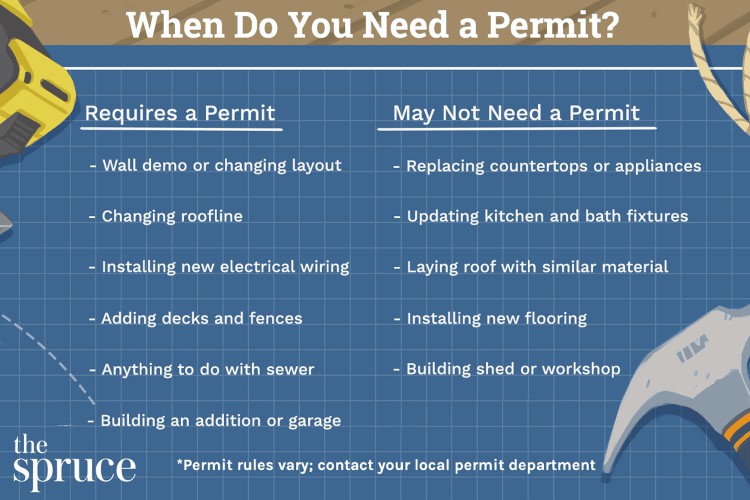
Permit Usually Required
Most localities will require a permit for these home projects:
| Topic | Project |
| Walls | Demolishing a load-bearing wall |
| Roof | Changing house's roofline |
| Layout | Whenever you expand the house in any way or alter the house's envelope, you will need a permit. |
| Electrical | Installing any new electrical wiring or adding circuits |
| Fences | Installing a fence over a certain height, such as 6 feet, triggers a permit. Most municipalities will consider an add-on such as shrubbery to be part of the fence. |
| Demolition | Parking your roll-off dumpster on a public street will require a permit. This is one of the rare permitting instances where your own property is not involved. |
| Decks | Building decks over a certain height, such as 30 inches above grade. |
| Sewer | Doing anything with a sewer line typically requires a permit. This permit action concerns not just your personal safety, but the health of those serviced by the main sewer line down from your house. |
| Addition | Building an addition will always require a permit. |
| Driveway or Garage | Building a garage or even a carport |
| Windows and Doors | Exterior doors, windows, and skylights that require a new opening |
| Fireplace and Chimney | Fireplaces, wood-burning stoves, and inserts nearly always require a permit because of the potential for fires. Chimney cleaning will be an exception, though. |
| Garages | Garage conversions |
| HVAC | Installing a new furnace or air conditioner |
| Water Heaters | Installation of a new water heater |
| Plumbing | New hose bibs for the outside of your house |
| Roofing | Re-roofing involving structural elements, including but not limited to sheathing, skylights, change of roof pitch and change of roof material where the total weight exceeds 10 pounds per square foot. |
| Swimming Pool | Installing either an in-ground or an above-ground pool requires multiple permits. |
Permit Might Be Required
| Topic | Project |
| Plumbing | Moving a sink, as this entails running new plumbing supply and drain lines |
| Walls | Demolishing a non-load-bearing wall usually requires a permit. Even though this type of work does not structurally compromise your home, some permitting agencies want to be overly cautious and make certain that do-it-yourself homeowners do not undertake dangerous repairs. |
| Doors and Windows | Replacing doors or windows on a one-for-one basis |
| Landscaping | Cutting down a tree on your property |
| Landscaping | Retaining walls more than 4 feet tall tend to require permits, as retaining walls have a tendency to topple above this height. |
Permit Often Not Required
As time goes by, more non-permitted actions become permit-required. In some municipalities, the following actions may still steer clear of permit requirements.
| Topic | Project |
| Roof | Laying in a new roof of similar materials. |
| Demolition | Parking your roll-off dumpster on your own property. However, if you happen to live in an association-controlled neighborhood, make sure you do not run afoul of your own housing association's rules. |
| Flooring | Putting in any kind of hard flooring (wood, laminate, vinyl, etc.) or carpeting |
| Plumbing | Replacing an existing sink |
| Painting | Interior or exterior painting |
| Kitchen | Replacing your countertops |
| Siding | Freshening up the exterior with new siding, as long as it is non-structural |
| Electrical | Minor electrical work, such as replacing a light fixture or an electrical outlet, often does not require a permit. Replacing a circuit breaker in-kind will not require a permit either. |
| Decks | Decks below a certain height (such as 30 inches) are not considered to be a safety hazard and therefore do not require permits. |
| Exteriors | One-story detached buildings like workshops and storage sheds as long as they do not receive electrical or plumbing services |
| Landscaping | Building tree houses under a certain size and height may not require a permit. However, habitable or live-in tree houses will need a permit. |
| Fences | Fences below a certain height, such as 6 feet |
| Property Boundaries | Permitting departments are not concerned with matters involving your boundary with your neighbor. Disputes are civil matters for the courts. |
| Landscaping | Retaining walls below 4 feet tall |
| Decks | Decking surface replacement, as long as you are not replacing structural materials |
| Bathrooms and Kitchens | Bathroom and kitchen fixture replacements without plumbing line modifications such as sinks and toilets |
| Appliances | Appliance replacement in the same location as long as you are not modifying gas, plumbing lines, or electrical circuits such as dishwashers, ranges, ovens, gas logs, washers, and dryers. |
The Spruce / Alex Dos Diaz
For Definitive Answers
A phone call to your local permitting office is the best way to determine if you need a permit. Many permit officers are happy to discuss permitting issues with anonymous callers as a way to avoid future code violations. Even then, the only definitive way to know if a permit is required is often to apply for a permit.
Play It Safe
It is always best to check (and double-check) whether you need a permit. Most counties and cities have websites for the building department. They usually have a FAQ section for permitting requirements. If inspectors find out that a project was done without a permit, they could require the removal of drywall or other surfaces to inspect the newly installed wiring or plumbing, for example. They could then require that the project be permitted, which could include a fine.
Also consider whether you'll be selling your home in the future. Home real estate inspectors often check public records to make sure new work has been permitted, and if you did work on your home without any necessary permits, it could hurt your prospects.
Recommended Articles

How to Scrape Paint With 3 Common Tools
Scraping paint is inescapable with many painting projects, especially exterior jobs like painting a house, a fence, or an outbuilding. If the existing paint is cracked, peeling, blistered, or otherwis

What Is the Modern Decor Style?
Modern style is based on a design movement birthed around the turn of the 20th century. It is often confused with contemporary style but embraces a past moment instead of the present one. While many p

5 Dinnerware Styles That Are So Outdated, According to Interior Designers
If you’re frequently hosting dinners and get-togethers at home, then chances are you'll obsess over tablescapes—from the dinnerware to the linens—almost as much as your home decor and furniture. "Dish

10 Living Room Remodeling Ideas That Pay Off
Living room remodeling pays off in so many ways. To start, it's one of the easier, less demanding rooms of the home to remodel—no plumbing, minimal electrical work, limited space. The living room focu

When Moving Isn't an Option, How to Turn Your Old Home Into Your Dream Home
If you've been unable to size up from your current home, you're not alone—according to a paper published by the National Bureau of Economic Research, there were 800,000 fewer moves in 2023 than the ye

Concrete Flooring Review: Pros and Cons
Concrete floors offer a durable, cost-effective, and low-maintenance option for various spaces in your home. Properly installed, they can last for decades and are versatile enough for more than just g

10 No-Demo Renovation Projects That Increase Your Home Value, According to Zillow
There are many ways to upgrade your home, whether refurnishing your basement or simply changing the lighting in your kitchen. But if you're lost on which ones to invest in, look no further. Zillow and
How to Choose the Best Paint for Bathroom Walls, Ceilings, Trim, and Cabinets
The best paint for bathrooms addresses the room's wet and overly humid conditions, prevents mold growth, resists mildew, and remains attractive for the long term. The best way to do this is to start w