
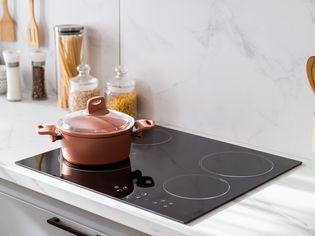
Induction cooktops look nearly identical to standard smooth-top ranges but there's much more to them than meets the eye. Functionally, there's a big difference between induction cooktops and ordinary electric cooktops, making induction cooktops safer, more environmentally friendly, and even faster than other ranges.
There are freestanding, slide-in, and drop-in models so you can choose the best induction range that perfectly fits your space.
Below, we've explained what an induction cooktop is, how it functions, and laid out the pros and cons, so you can decide if an induction range is right for you.
What Is an Induction Cooktop?
An induction cooktop is a cooking surface with an electromagnetic field situated beneath the surface. When turned on, the electromagnetic field reacts with magnetic cookware to create heat through energy transfer.
Want more home reno project tips and inspiration? Sign up for our free daily newsletter for the latest how-tos, reno guides, and more!
How Does Induction Cooking Work?
While an induction stove uses electricity to create heat, it doesn't do so in the same manner as an electric stove. Electric cooktops use electricity to heat an element, either beneath a glass top or directly on the cooktop in the form of a coil.
This cooktop then gets extremely hot. When a pot or pan is placed on the cooktop, heat is then transferred into it, with much of that heat being lost in the process.
An induction cooktop doesn't use electricity to heat the cooktop itself. Instead, the electricity is used to power an electromagnetic field beneath the glass. When a magnetic pan is placed on the cooktop, the magnetic reaction causes the pan to heat up. This direct connection efficiently heats the pan without ever heating the cooktop itself.
To cook on an induction cooktop, you must use induction-compatible cookware. This is because the magnetic field the induction cooktop uses to create heat must have magnetic cookware to react to.
Cookware made from materials like aluminum, copper, and glass won't work with induction, as these materials aren't magnetic—however, traditional cookware like stainless steel, cast iron, enameled iron, and nickel will.
Pros of Induction Cooktops
Like any other style of cooktop and range, there are both advantages and disadvantages associated with induction cooktops.
Here are some of the notable pros of induction cooktops:
- Safety: Since an induction cooktop's magnetic field heats the pan itself rather than the cooktop, you don't have to worry about the cooktop getting hot if you forget to turn it off after removing your pan.
- Energy-Efficient: Induction cooktops are more energy-efficient than both electric ranges and gas ranges, which saves you money while being environmentally conscious.
- Easy to Clean: Induction cooktops have a solid glass cooktop, much like that of a glass or ceramic electric range. This solid surface is much easier to clean than a gas range or a traditional electric stove with coil elements. Plus, because the cooktop itself doesn't heat up, there's much less room for food to burn on.
- Cooking Speed: The heat creation from the magnetic reaction of an induction cooktop is second to none. Induction-compatible pans heat quickly and evenly, making cooking quick and easy.
Cons of Induction Cooktops
Induction cooktops may also have some downsides, here are some must-know cons:
- Lacks the Feel of Gas: The flame, itself, of gas stoves is a favorite among chefs. It's easy to read and react to, which is a major part of cooking. Induction cooktops lack a flame or even a glow, which leaves some users wanting a visual representation of heat.
- Requires Specific Cookware: If you switch to induction but don't already have the appropriate cookware, prepare to shell out additional money for induction-compatible cookware.
- Expensive: Induction cooktops and ranges are typically more expensive than their direct competition of electric and gas ranges. Furthermore, switching from gas to induction will likely require you to hire an electrician to run the proper electrical line.
Installation and Costs of Induction Cooktops
Most induction ranges use the same electrical connection as a standard electric range. So, if you're going from electric to induction, you simply unplug the old stove and plug the new stove in.
However, going from gas to induction will require you to install a dedicated electrical line if one isn't already present, which likely is the case as it's unnecessary for a gas stove. If this is the case, you will have to hire an electrician, which is estimated to cost $50 to $100 per hour plus material costs.
- How do I know if my cooktop is induction?
The easiest way to tell if your cooktop is induction or not is to turn it on and note what happens. If it gets hot and glows, it isn't induction. If it gets slightly warm with no glow, it likely is induction. However, some modern induction cooktops feature lights to emit a glow.
What is the difference between an induction cooktop and a regular cooktop?An induction cooktop utilizes an electromagnetic current to transfer heat to magnetic cookware, whereas a regular cooktop simply uses electricity to heat the cooktop itself.
What are the disadvantages of an induction cooktop?One of the main disadvantages of induction cooktops is that, while they perform well, they lack the feel of a gas cooktop and can be uncomfortable to use until you get used to them. This is mainly due to the fact that the heat production of an induction cooktop is very uneventful, whereas gas cooktop has a direct visible representation of how much heat it's producing.
Recommended Articles
 ROOM-DESIGN-AND-DECORATING
If You're Still Doing This in Your Kitchen, Designers Say It Will Always Look Cluttered
Key Points Keep counters clear by only displaying essential appliances for a clean, minimalist look.Use smart storage like appliance garages, hidden outlets, and bar carts to reduce clutter.Declutter
ROOM-DESIGN-AND-DECORATING4 Easy Kitchen Upgrades That Instantly Make Your Home Look Good, According to Designers
Key Points Swap out cabinet hardware and light fixtures to instantly modernize your kitchen with minimal effort.Add sheer curtains to bring in more natural light, which will create a bright ambianceSt
INTERIOR-REMODEL-AND-REPAIR5 Home Projects You Should Always Leave to the Pros, According to Contractors
Renovating your home is a rollercoaster—between deciding where to splurge and where to save, remembering every project that needs doing, and picking a room to start with, there are so many factors to
INTERIOR-REMODEL-AND-REPAIRI Faked an Apartment Reno By Adding Renter-Friendly Architectural Details—Here's How
This story is a part of our Old House New Issue, where we explore why people are no longer moving in 2024, and how to renovate your current home to make it work for you. To learn more about where to s
INTERIOR-REMODEL-AND-REPAIRWe Asked Real Estate Pros Their Best-Kept Secrets to Sell Your House Faster in 2025
When you've finally decided to sell your home, the process of doing so can be challenging and confusing. Whether it's going through numerous open houses or waiting around for the right offer (or any o
HOME-IMPROVEMENTLaminate Flooring Review: Pros and Cons
Laminate flooring emerged on the residential flooring scene decades ago as an easy-to-install, attractive, and durable alternative to solid hardwood flooring. Its technology has advanced with sharper
HOME-IMPROVEMENT10 Best Basement Floors
Even when the weather is dry, basement flooring does not follow standard rules. Due to its proximity to the ground, it might leach residual moisture in vapor. Some basements can also experience up-to-
EXTERIOR-REMODEL-AND-REPAIRWhole-House Remodel: Where to Start
With a whole-house remodel, the entire house is transformed. It's an exciting step that can also be a bit intimidating, given the scale of the project and the amount of planning that is required. The