Without adequate ventilation, your bathroom is at risk for long-term damage to walls, ceiling, flooring, and trim from mold, mildew, and rot. But choosing a bathroom exhaust fan often presents a paradox: You want a powerful fan but not one that is so loud that no one will use it. On the other hand, if you bring down the noise levels to near-silence, is the fan doing its job well enough?
What Is a Bathroom Exhaust Fan?
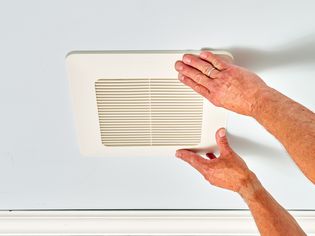
Bathroom exhaust fans are usually placed near or in the ceiling of a bathroom. They are necessary for expelling odors and for keeping moisture levels in check.
Before You Buy a Bathroom Exhaust Fan
Noise and efficiency do not always equate. The perfect bathroom fan is both quiet and has sufficient room-clearing capability. Cost also must be figured into the decision, as few consumers wish to buy a quiet, efficient fan if it costs a fortune. A few bathroom fans strike a good balance between capacity, noise rating, and cost.
Things to Consider When Choosing a Bathroom Fan
Sones
Sones, not decibels, are the industry-accepted units of measurement used when evaluating noise levels for bathroom fans. Sones are a subjective measurement, based on the psychological perception of a sound's intensity. Single-speed bathroom fans range from 0.3 sones or less for the very quietest models to 4.0 sones or more for the loudest economy models.
Air Flow Capacity
The effective power of a bathroom exhaust fan is measured in cubic feet per minute (CFM). This is the volume of air that the fan will suck out of the bathroom within one minute.
As a general rule, a bathroom should have an exhaust fan that pulls out a minimum of 50 CFM or greater. To take full advantage of your fan's cubic foot per minute capability, it helps to supply enough intake, or makeup, air by leaving the bathroom door slightly open while the fan is running. Fans don't just expel bad air; they create air exchange by pulling in the fresh air at the same time. If you starve the fan of makeup air, it won't do its job very well. You can crack the door open after using the toilet or taking a shower.
Efficiency Per Sone Rating
Ideally, it is best to have a fan that sucks out massive amounts of air at a lower noise cost, much like a car that goes farther on less fuel. While noise and efficiency do not perfectly equate, there is still a rough correlation between the two factors. Sones do generally increase as air volume increases; think of the sound of a range fan or household fan increasing as you move up each level of volume. With bathroom exhaust fans, most of the < 0.3-sone fans move 80 CFM or less, while most of the 1.0-sone and louder fans move 140 CFM or more. But it is not quite that simple. Sometimes, a few outliers move more air with less noise.
One way to evaluate the data and better standardize CFM and noise is to bring the two numbers together. The intersection between sones and air volume (dividing sones by CFM) gives you a better view of a bathroom fan's value than just by looking at noise or volume alone. Lower CFM-per-sone numbers are better. For example, a fan rated at 1 sone and 1 CFM would produce a CFM-per-sone rating of 1. If a fan with the same sones were able to pull out 2 CFM, its CFM-per-sone rating would be 0.5.
As an extreme example, consider one popular bargain bathroom exhaust fan that has a noise level of a whopping 4.0 sones, yet it expels only 50 CFM. Its CFM-per-sone rating is 0.0800, about 20 times less efficient on a CFM-per-sone basis than the WhisperQuiet and higher than most other bathroom fans on the market.
Another bathroom exhaust fan, of the type purchased by commercial establishments, pulls 470 CFM at the cost of 8.0 sones. Its sone-to-CFM rating is 0.0170, which is far lower than the previous bargain fan.
Mounting Mechanism
When choosing a bathroom exhaust fan, don't forget to consider the mounting mechanism. Is there an existing mechanism that you need to fit a new fan to? Or will a new mechanism fit in your bathroom? Would you be able to install it yourself, or would you need to hire labor? These are all crucial questions.
Cost
The last dimension to consider when purchasing a quiet bathroom fan is its cost. A super-quiet bathroom fan may not be worth purchasing if it is beyond your remodeling budget. Yet an ultra-cheap bathroom fan might be so loud that it rarely gets used. For example, the Broan 688 is a workhorse that contractors have been installing in bathrooms for many years. If you are looking for an inexpensive and dependable exhaust fan, the Broan 688 might be right for you. Its price has remained the same over the last five years. Yet, at 4.0 sones, quiet it is not.
- How many sones is a quiet bathroom fan?
A quiet bathroom exhaust fan will be rated at 1.5 sones or less.
Are quiet bathroom fans expensive?Quiet bathroom fans do not have to be expensive. You can find decent models around $150 or less.
Is it necessary to have a fan in your bathroom?A properly installed bathroom fan will get rid of not only odors but also, and more importantly, excess moisture, preventing mold growth.
When should you replace your bathroom fan?A good rule of thumb is to replace your bathroom exhaust fan every ten years.
Recommended Articles
 INTERIOR-REMODEL-AND-REPAIR
The Small Home Upgrades That Instantly Improve a Space, According to Spruce Readers
For September, we asked our loyal Facebook followers what small adjustments they made in their home that really improved their space. And as per usual, the answers were thoughtful, intriguing, and sma
INTERIOR-REMODEL-AND-REPAIRI Faked an Apartment Reno By Adding Renter-Friendly Architectural Details—Here's How
This story is a part of our Old House New Issue, where we explore why people are no longer moving in 2024, and how to renovate your current home to make it work for you. To learn more about where to s
INTERIOR-REMODEL-AND-REPAIR5 Small Home Upgrades Under $5,000 That Make a Huge Impact, Designers Say
Changing your lighting can be an affordable way to bring impact to a room. Layer various types or swap out dated styles.If you're looking for a budget-friendly and quick update, consider painting your
HOME-IMPROVEMENTLearn the Rules for Overhead Clearance on Power Lines
Overhead power lines are subject to strict guidelines for minimum height clearances over streets, sidewalks, alleys, driveways, and other traffic areas. This is a safety consideration, aimed at keepin
HOME-IMPROVEMENTThe German Habit You Should Try for Fresher Indoor Air This Winter
While keeping your windows closed all winter may keep your home warm, it also traps mold, bacteria, and allergens inside the house, where they will gradually build and affect your indoor air quality.
OUTDOOR-BUILDINGHow Much Does a Retaining Wall Really Cost?
Retaining walls control erosion and drainage problems, and they add usable space for gardens, patios, or detached living units. On average, a retaining wall costs about $4,800. Meet the Expert Joe Rab
BATHROOM-REMODEL-AND-REPAIRUsing Hardwood Flooring in a Bathroom
There are benefits and drawbacks to wood floors in bathrooms. Hardwood flooring is a popular surface covering material that has been used in a variety of interior spaces since the dawn of modern const
BATHROOM-REMODEL-AND-REPAIRThe Best 5x8 Bathroom Layouts to Save Space
While 5 by 8 feet may seem like a small size for a well-designed bathroom layout, it's actually the most common floor plan that can still encompass a sink, a shower and tub, and a toilet. That said, t