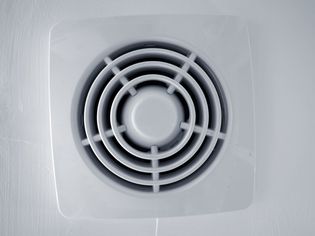
Choosing a location when installing a bathroom vent fan depends on where the fan will work best for removing moisture and how to run the ductwork efficiently. Read on to find out what a bathroom fan does, how best to run the ducts, and the steps you need to take.
Why Install a Bathroom Vent Fan?
A bathroom vent fan is necessary to remove excess moisture from the room during baths and showers. Without a bathroom vent fan, a stuffy room with no outlet for steam and condensation will develop mold, mildew, and water spots on the ceilings, walls, and flooring. A bathroom vent fan pulls the moist air out of the room to prevent muggy conditions that fog up windows and mirrors and create musty odors.
Building codes do not always require bathroom exhaust fans if the room also has a window. However, it's best to install a bathroom exhaust fan that can be utilized year-round because it can be uncomfortable or less energy efficient to open windows during especially cold or hot weather.
Follow the Moisture
First, the fan should be located in the area of the bathroom that is exposed to the most moisture. This is usually the area over the bathtub or shower. You can place the fan directly over the bathtub or shower base, but it's sufficient to position it anywhere near the bathing area.
The goal of the exhaust fan is primarily to remove wet, humid air that can cause mold or moisture damage, and your bathroom will exhaust most quickly if you position the fan over the area with the most moisture. If the bathroom has a tub and shower or a whirlpool tub, the fan should go somewhere between the two fixtures.
If the bathing area is in its own room, that room needs its own fan, and you might want to add another fan for the main bathroom area or wherever the toilet is located.
Plan Your Vent Ductwork Route
Bathroom exhaust fans must be vented through the roof or the side of your house. Plan the location for the bathroom exhaust fan so that the duct has the shortest and most direct route to the roof or wall vent. It's best if the fan unit is within 6 feet of the exterior vent cap, where all the moist air escapes to the outdoors using the straightest route possible. Longer duct runs make the fan less effective and increase the likelihood of condensation inside the duct.
You can terminate the duct through the roof, a gable wall, or even a soffit (if you use a special vent cap). But avoid venting through a side wall below a soffit (the eave overhang of the roof), as this can trap rising, moist air under the eave overhang.
Check the Attic
Head into the attic with a tape measure to scout your bathroom exhaust fan location from above the ceiling. If necessary, measure from an exterior wall, a plumbing vent pipe, or electrical boxes in the ceiling to find your bearings relative to the bathroom fixtures below. (It also helps to have a helper below measuring inside the bathroom and communicating measurements by cell phone.)
Ensure you can install the fan between two ceiling joists and that there is enough room to transition from the fan housing to the duct. Also, ensure the vent cap will be well clear of obstructions and trouble areas of the roof—things like roof valleys, skylights, chimneys, or furnace or water heater vents.
Drill a Locator Hole
Before cutting the hole in the ceiling for the fan housing, use a drill and a small bit to drill a pilot hole through the ceiling material at the center of the fan location. Head back to the attic to confirm that the location will work and that no plumbing or wiring runs are in the way. Using a locator hole is much more accurate than measuring from neighboring features. Use the same technique when it's time to cut a hole in the roof or attic wall to install a vent cap to terminate the ductwork.
- Can a bathroom fan be vented into the attic?
No, you can't vent a bathroom exhaust fan into the attic because it's against building codes and can cause mold and damage to the wooden structure.
Should a bathroom fan be on during or after a shower?Turn on a bathroom vent fan just before you begin your shower or bath, and keep it on for about 20 minutes after the shower is over to remove residual steam.
Is it better to vent a bathroom fan through the wall or the roof?You can vent a bathroom exhaust fan through the wall or roof. Either is fine, but the shorter the route, the better.
Recommended Articles
 PAINTING
7 Easy Home DIYs for Your Best Thrift Store Finds, Straight From Designers
Thrift stores aren't only full of potential home goods, but they're teeming with objects that make for perfect DIY supplies. Even the most unsuspecting picture frame or glass bowl can end up transform
INTERIOR-DECORATING7 Types of Wood Paneling for Your Home
Wood paneling is often associated with the rich, elaborate look of older homes. But wood paneling is increasingly being used in contemporary homes to protect walls and to create visual interest. Wood
HOME-IMPROVEMENTHow to Use Cement Backer Board
Cement backer board is an inexpensive, convenient building material that makes tiling, flooring, and countertop projects go faster and look better in the end. Most importantly, cement backer board co
OUTDOOR-BUILDINGHow Much Firewood Is in a Cord and How to Store It
Burning wood in a fireplace or other wood-burning appliance can be a comforting way to generate heat and ambiance. Depending on firewood costs and availability in your area, burning wood could reduce
OUTDOOR-BUILDINGPressure Vacuum Breaker Basics
A pressure vacuum breaker (PVB) is a safety component of irrigation systems. It stops non-potable irrigation system water from flowing back to your home's drinking water supply. Learn why a pressure v
EXTERIOR-REMODEL-AND-REPAIR8 Surprising Things You Can Actually Clean With a Pressure Washer, According to an Expert
Pressure washers can't be used to clean everything, but they can be useful tools.Driveways, sidewalks, decks, patios, and fencing can all be cleaned with a pressure washer.Pools, artificial turf, tras
BATHROOM-REMODEL-AND-REPAIRDiagnosing Faucet Leaks
Some faucet leaks are pretty obvious to spot—when a faucet drips from the spout, even when the handle is turned off, there is no misunderstanding about the fact that your faucet is leaking. However, n
KITCHEN-REMODEL-AND-REPAIR5 Types of Kitchen Lighting
Kitchen lighting can be divided into either general lighting (the entire room) or work lighting (specific areas). Within those two broad categories are ceiling lights, recessed lights, track lights, p