Bathrooms accumulate smells and moisture, leading to potentially hazardous mold and mildew. All bathrooms benefit from some exhaust venting system. Bathroom exhaust fan code requirements provide helpful information about bathroom windows, fan capacity, and moving the air in the bathroom. Read on to see what type of bathroom fan venting you need, if any.
| Topic | Code | Summary |
| Windows | Section R303.3 | A window in the bathroom, when used in lieu of an exhaust fan, must be at least 3 square feet in area. |
| Fans | Section R303.4 | If your local code includes this section, it may mean that an exhaust fan is required and that an open window is not a code-approved substitute. |
| Porting air | Section M1507.2 | This section states that vented air needs to be sent to the exterior and not into an interior space such as an attic. |
| Fan capacity | Section M1507.4 | The fan minimum is 50 cubic feet per minute (cfm) intermittent or 20 cfm continuous. |
What Is the Bathroom Fan Venting Code?
The bathroom code addresses the issue of moving odor- and moisture-laden air from the bathroom to the outside. Surprisingly, some building codes do not require bathroom fans. All municipalities have different requirements, but some do not draw a hard line on requiring exhaust fans. Bathroom ventilation is needed in those areas, but it can be from a window or fan—you choose.
Building code is a model code that each community can adopt and adapt according to its needs. So, you must check with your city or county planning and permitting department to determine code requirements regarding bathroom fans. Also, the code numbering in your area may differ from those listed here.
Bathroom Exhaust Fan Venting Code Summary
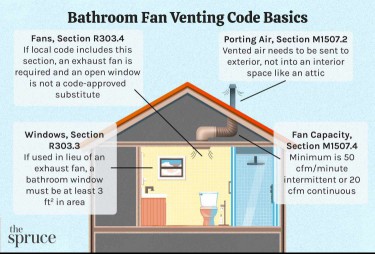
The Spruce / Julie Bang
Section R303 of the International Residential Code discusses light and ventilation regulations in general. Section R303 works with all of International Residential Code Section M1507, which covers Mechanical Ventilation.
Section R303.3: Bathrooms Must Have Windows
When a community adopts this section, it essentially says that bathrooms must have open windows for venting purposes. The code reads that the window must have an "aggregate glazing area...of not less than 3 square feet (0.3 m2), one-half of which must be openable."
Summarized, if you install a window in the bathroom, it must be at least 3 square feet in area. This window only needs to be able to open halfway, meaning the total open window space only needs to be 1 1/2 square feet.
Open windows can provide highly effective ventilation in bathrooms without showers or tubs. Without bathing facilities, far less moist air is produced. While powder rooms can benefit from exhaust fans, they can usually operate just as well with a window that opens.
Section R303.4: Bathrooms Require Exhaust Venting Fans
In some communities, this section may be instead of Section R303.3 or in addition. If Section R303.4 is included but the previous section has been struck-through or not included, this may mean that your bathroom must have a bathroom fan and that a window cannot be used as a substitute venting method. Be sure to clarify this with your local permitting department.
Section M1507.2: Exhausted Air Terminal Point
This section notes that air exhaust from the bathroom must be sent outdoors, not indoors, to the same residence or indoors to any other dwelling unit. It cannot move air to a crawlspace or attic.
While this may seem obvious, homeowners may direct the vent into either of these locations out of convenience. While this is not smart, it is understandable: attics and crawlspaces are often the shortest possible route for the vent. Even well-meaning homeowners may explore their attics only to find ducting that has become disconnected. Exhaust fans may run for years like this before the break is noticed.
Routing vertically out of the roof or through the upper part of the wall (to the exterior) is time-consuming and invasive. The end of the vent run should also have a grille or screen to prevent vermin from entering your home.
Section M1507.4: Exhaust Capacity
This section discusses the exhaust fan's minimum capacity: 50 cubic feet per minute (cfm) intermittent or 20 cfm continuous.
Exhaust Fan Sound (Sones) Ratings
While not required by the building code, purchasing a quieter, low-sone exhaust fan can increase the comfort level of your bathroom by keeping the noise level down.
| Sones | Sounds Like | With Exhaust Fans |
| 0.3 sones or less | Barely perceptible up close; silent from a distance | The quietest possible sones level for exhaust fans |
| 0.3 to 0.9 sones | A rushing air sound in a small environment like a bathroom; not annoying to most people | A majority of exhaust fans fall in this range |
| 1.0 sones | Sounds like a refrigerator's compressor | Exhaust fans become less expensive as they reach 1 sones and more |
| 3.0 sones | Sounds like a clothes dryer | The maximum noise level found in exhaust fans |
Why Your Bathroom Should Have an Exhaust Vent Fan
Bathroom venting fans are about more than just eliminating noxious odors. Foul odors are annoying but hardly life-threatening, and they do not impact the integrity of the building structure.
Bath exhaust fans are about keeping your house in top shape by moving water out of your bathroom. Water is everywhere in a bathroom: splashing on the floor, beading on the walls, dripping down the mirror. And there is another invisible place where you will find water in the bathroom: in the air.
Because windows provide light and ventilation, you must install artificial lighting if you choose the fan-only route. The electrical code requires that habitable rooms be supplied with a switch-controlled light.
- Does an exhaust fan need GFCI protection?
The fan must be connected to a GFCI-protected circuit directly above a shower or bathtub. This can either be a GFCI outlet or upstream, in-line GFCI protection.
Should you use an exhaust fan or an open window?Though an open window is allowed by code, it is passive air ventilation. An exhaust fan is active air ventilation. Venting fans pull moisture-laden air out of that small space, slowing or preventing it from condensing on walls, the ceiling, or inside the ceiling itself.
What is the danger of uncontrolled bathroom moisture?When moisture spreads in a bathroom, mold, mildew, and even insects proliferate. Costs spiral as you put the home under a pest control contract and undergo extensive remodeling work to shore up weakened studs. It can be an ugly sight to crawl above a poorly ventilated bathroom's ceiling. You might find mounds of black-moldy blown-in insulation, joists, and rafters weakened from years of moisture abuse.
How far can you run ducting for an exhaust fan in the bathroom?There is no guidance on the duct length; only a straight run is preferred to a duct with bends or elbows. On average, the vent duct can run from 2 to 30 feet.
Recommended Articles
 PAINTING
How Many Coats of Primer Do You Need?
Should you always prime before painting? If so, how many coats of primer do you need? There's no one answer because the number of coats of primer depends on a few factors, such as the color you're pai
INTERIOR-DECORATING3 Design Trends Designers Regret Following—and What They Wish They Had Done Instead
It’s no secret that design trends don’t always stand the test of time. Sometimes, buying into a fleeting design trend can lead to major regrets down the line, especially if it's expensive or difficult
INTERIOR-DECORATINGWarm Lighting Basics You Should Know
Warm lighting feels natural to us in the evenings and promotes relaxation. Our circadian rhythm (the body and brain's natural 24-hour cycle of changes) relies on warm lighting to help us unwind, relax
INTERIOR-DECORATING6 Decor Mistakes That Were Making My Apartment Look Totally Outdated
As someone who writes about interior design for a living, my own style is ever-evolving—it's hard to leave my space alone when I'm constantly gathering inspiration and tips from the pros. Over the yea
ROOM-DESIGN-AND-DECORATING20 Small Living Room Ideas With Dining Tables That Have Big Style
Just because your living room is small doesn't mean you can't work a dining table into the mix. Small apartment dwellers have become masters at carving out nooks for eating and entertaining. Below we'
OUTDOOR-BUILDINGCan You Build on a Property or Utility Easement?
Easements can exist quietly on your property, not affecting you for years or decades. Then, when deciding to bump out your house, put on an addition, dig a pool, or erect a fence, you find a legal eas
OUTDOOR-BUILDINGTurning Your Shed Into a Tiny House? Here's What to Know
Turning a shed into a tiny house expands living or creative spaces, opens up short-term rental income opportunities, or provides a place for family members to stay. Learn how to turn a shed into a tin
EXTERIOR-REMODEL-AND-REPAIR8 Things to Do Right Now to Get Your Deck Ready for Cold Weather
When the weather is beautiful, a well-cared-for deck is one of the best ways to enjoy it. However, when the temps take a downward turn, it's crucial to take some time to prepare your deck for the wint