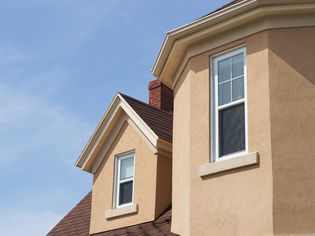
Stucco is a durable, versatile exterior finishing plaster coat found on homes nationwide. Though fiber-cement panels, vinyl siding, and plywood are popular siding materials, stucco has been used for centuries and continues to serve homes well.
House exteriors are composed of many layers that work together. The outermost layer, which is the siding or cladding, is most important to a home's lifespan. Unlike other forms of siding, stucco applies equally well to masonry and wood-sheathed homes.
Wood-Sheathing
Sheathing is the material used to cover a structure's floor, wall, and roof framing. Wood-sheathed homes have sheets of wood forming the exterior walls, which can then be covered with siding, house wrap, and sometimes, external insulation. Stucco can be applied to wood-sheathed walls.
What Is Stucco?
Stucco is a cement-type mixture of Portland cement, lime, sand, and water. Its ingredients are mixed and applied wet and then dried to form a durable, hard finish.
Most commonly used on home exteriors, stucco can also be used for interior walls and ceilings as a decorative finish and painted.
It is not necessary to mix stucco with raw ingredients. You can buy pre-mixed stucco finishes at most home centers, which require only the addition of water.
Types of Stucco Finishes
- Sand finish: This popular stucco finish has a grainy, textured look due to the large amount of sand in the mix ratio.
- California finish: Sometimes called a cat face finish, a California stucco finish has a generally smooth surface interspersed with rougher areas.
- Smooth finish: As the name suggests, a smooth stucco finish is smooth, level, and featureless.
- Mission finish: A mission or Santa Barbara stucco finish is left natural and unpainted.
Stucco Application Methods
Stucco is applied using one of three methods:
- One-coat method: Comprised of Portland cement, sand, fibers, special proprietary chemicals, and water, a one-coat method only requires a single application, it applies faster, and can go over rigid foam board and lath.
- Two-coat method: Used to coat brick and block walls, this method requires a bonding adhesive to keep the stucco adhered to the walls. This method eliminates the brown coat, and the finish coat is applied directly to the scratch coat.
- Three-coat method: The traditional three-coat method is the most durable. It's defined by its three coats: the scratch coat, brown coat, and finish coat. This method can be used over wood sheathing or masonry surfaces. The scratch coat starts with an asphalt-infused paper and a rough, scratched layer. Next is the base layer or brown coat stucco, then a finish coat for texture and color.
Pros and Cons of Stucco
Inexpensive
Customizable
Long-lasting
Easy to maintain
Fragile
Long curing time
Frequent maintenance
Installation not DIY-friendly
Pros
- Easy to customize: Stucco is tinted to add color. To ensure colorfastness, it can be painted with ordinary exterior house paint. Stucco can be textured in various ways, lending itself well to creative embellishments.
- Inexpensive: Stucco is considered one of the least expensive types of siding because it does not use expensive materials. Most stucco finishes are created from mixes, but you can also make your finish from raw ingredients.
- Resists moisture and inclement weather well: A stucco house finish provides an excellent seal against rain and snow because it is seamless, unlike nearly every other form of siding. Seams allow water and air into a home. Even seams that appear to be well-sealed may eventually open up.
- Long-lasting: Stucco, when well-maintained, can last for 50 to 100 years.
- Resists fire, mold, rot, and termite infestations: The composite materials of stucco naturally deter fire, rot, mold, and termites from invading the outer structure of a home. However, stucco's rugged texture and porous spaces can provide small spaces for persistent mold to set in.
- Easy to maintain: Stucco has one of the lowest annual maintenance costs compared to other siding materials. Maintenance usually involves inspecting the exterior and filling cracks. Because of its resistance to environmental factors (moisture, mold, insects, rot), it keeps maintenance needs to a minimum.
Cons
- Prone to impact damage: Stucco is fragile and can easily be damaged.
- Not easy to DIY: The installation of stucco requires mixing, color matching, and application with a trowel. Initial application and repairs are usually best left to the experts.
- Long curing time: Curing or drying stucco requires at least 24 to 36 hours for each coat.
- Frequent maintenance: Stucco is easy to maintain, but it is not maintenance-free. You must inspect it regularly, patch cracks, and hose it down to keep dust and dirt from accumulating.
- Installation cost: Although the materials are cheap, the initial layout for professionally installing a stucco finish to the exterior of a house is time-intensive, bringing up the installation costs.
How To Apply Stucco
The steps you need to apply stucco depend on your choice of method, from one to three coats. You eliminate the scratch or brown coat in one- or two-coat installations. In general, the three-coat method includes the following steps:
- Apply bonding agent or stucco wrap: This layer acts as a stabilizing element for the plaster to adhere properly to wood, metal, or plastic lath.
- Apply scratch coat (base coat): Using a trowel, apply a 1/4- to 1/2-inch layer of the plaster. It may need up to 36 hours to cure.
- Apply a brown or leveling layer: Once the scratch coat is dry, use a trowel to apply a second layer. It also needs to dry thoroughly before adding the last coat.
- Apply finish coat: After waiting another 36 hours for the brown layer to dry, apply the finish coat with a trowel, making the texture you want to be visible for the home's exterior.
- Paint: This step is optional. Stucco can be painted or tinted. Acrylic latex is the better choice when applying paint.
Stucco on Masonry Siding
One of the best substrates for stucco is concrete masonry. Concrete masonry is stable and less prone to expansion, contraction, and other movements that may crack the stucco.
On concrete masonry, little more than a scratch coat is needed below the stucco finish. A scratch coat is a base layer of cementitious material scratched horizontally with a comb-like tool.
Stucco on Wood Siding
Wood-sheathed buildings require more preparation for a stucco finish than masonry buildings.
Wood sheathing itself will not provide a good base for a stucco finish. You must layer it with a house wrap or other waterproof building paper and then with self-furring metal lath. This lath provides the grip for the scratch coat to hang onto.
After the scratch coat, apply a brown coat to provide a smooth surface for the subsequent stucco finish.
Can be textured as well as tinted
Materials are low-cost compared to other styles of siding
Tight seal against weather
Long-lasting when well-maintained
Repairs may need expert attention
Difficult for DIYers to install
Not appropriate for every locale
Easily chips and fragments upon impact
How To Maintain Stucco
The rule of thumb with stucco is to inspect your home's exterior for cracks regularly. Weathering may cause micro-cracks that can grow over time, and direct impacts may make holes.
Stucco is easy to patch. Use paintable acrylic caulk to seal any fissures. Large holes or significant damage are best left to a stucco repair professional.
Point sprinklers and gutter downspouts away from stucco surfaces. Although stucco resists water, it's not impervious if cracks occur. Also, continuously introducing damp conditions combined with organic matter (dirt and plant life) invites mold and fungal growth.
How To Clean Stucco
After repairing cracks, clean the stucco once or twice a year. To remove stains, mix a bleach and water solution. For stubborn stains, mix borax and dish soap into warm water.
- Preliminarily clean stucco walls with a garden hose sprayer to remove dirt and dust.
- Remove stains or algae, mix one part bleach with four parts cool water.
- For more difficult stains, start with 1 gallon of warm water in a bucket, then add 1/4-cup borax and 1 tablespoon of liquid dish soap
- Clean unpainted stucco with CLR (calcium, lime, rust) cleaner.
- Avoid using a power washer on stucco, though a very low-pressure setting may be acceptable for strong stucco.
- Is stucco a type of concrete or cement?
Stucco, concrete, and cement have similar compositions. Stucco has lime in it, making it more breathable. Stucco can be troweled on and adhered to vertical surfaces. Concrete can only be poured or molded.
Is stucco cheaper than concrete?Stucco is cheaper than concrete. Stucco and concrete are not similar building materials because concrete is poured and is used mainly for commercial buildings. Fiber cement siding is also made of Portland cement but also includes fly ash and wood pulp and is formed into boards or shingles that resemble masonry or wood. It is a cheaper building material, easier to install, and requires less maintenance than stucco.
What is stronger than stucco?Most other siding materials are stronger than stucco, which is fragile and prone to damage upon impact. Fiber-cement, wood, and vinyl are stronger than stucco.
How long does stucco last?Stucco has a typical life span of 50 to 100 years or more, depending on environmental and climate factors.
Why can moisture be a problem for stucco?Though a stucco finish in good condition resists moisture, cracks in stucco can cause a problem, letting in moisture. Once moisture finds its way behind a stucco finish, it is very tough to repair, and the water will cause structural damage over time.
Recommended Articles
 PAINTING
Should You Use a Steam Cleaner to Remove Paint? Why Pro Painters Don't Recommend It
Paint is challenging to remove from surfaces. With many methods available—scraping, stripping, sanding, and more—it's worth asking if you can use a steam cleaner to remove paint, as well. Steaming isn
HOME-DESIGN-STYLESWhat Is Shabby Chic Style?
Shabby chic is an interior decorating style that blends vintage and cottage elements in soft, romantic colors and textures to create an elegant, yet worn and welcoming look. A favorite for decades, sh
ROOM-DESIGN-AND-DECORATING6 Things That Are Secretly Making Your Countertops Look Bad, According to Design Pros
Key Points Store small appliances, spices, and paper towels off the counter to reduce visual clutter.Keep junk mail and schoolwork in drawers or wall organizers, not on your kitchen surface.Use hooks
INTERIOR-REMODEL-AND-REPAIRSatin vs. Brushed Nickel: Which Finish Is Actually Right for You?
When comparing similar metallic finishes like satin nickel vs brushed nickel, learning the subtle differences before purchasing can make or break your home's aesthetic. Beyond appearance, learning the
HOME-IMPROVEMENTHow Much Does Window Replacement Cost? Top Brands and More
Home window replacement is a necessity when problems arise, such as air leaks, water infiltration, thermal leaks, fogged glass, or insect intrusions. When it's time to choose windows for your home, yo
HOME-IMPROVEMENTHow to Turn Off the Power to Your House
All homes have a main electrical service panel, a circuit breaker panel, or a fuse box in older homes. This panel receives power from the local electrical utility and sends it to the various branch ci
EXTERIOR-REMODEL-AND-REPAIRLearn the Rules for Overhead Clearance on Power Lines
Overhead power lines are subject to strict guidelines for minimum height clearances over streets, sidewalks, alleys, driveways, and other traffic areas. This is a safety consideration, aimed at keepin
KITCHEN-REMODEL-AND-REPAIRIs Cabinet Refacing Worth the Price? A Home Reno Pro Breaks Down the Cost
Cabinet refacing upgrades a kitchen or bathroom without the high cost or disruption of complete cabinet replacement. On average, a full-size kitchen with about 30 feet of cabinets costs $8,300 for cab