A carport can be a simpler solution for maintaining your vehicle than a garage. For many homeowners, building a carport is the ideal compromise between leaving the car unprotected and the hefty expense of building a garage.
Find out how to build a carport, including choices that range from custom and pre-built carports to improvised alternatives like awnings and sun shades.
Building a Carport vs. Garage
| Carport | Garage |
| Not enclosed | Enclosed |
| Not secure | Secure |
| DIY or hire contractor | Hire contractor |
| May add to property value | Adds to property value |
| Low to moderate expense | Expensive |
Though a garage is usually the best way to protect a vehicle, it's not always possible or desirable to build a garage.
Both a carport and a garage have a roof to protect the vehicle from snow, tree debris, sun, and bird droppings,
Garages have four walls for side protection, and they can be locked up. Carports are usually open-sided though some custom and pre-built carports can have one or two sides. Carports cannot be locked up, and some jurisdictions require carports to be open-sided.
Garages can cost upwards of $50,000 to build. Custom-built carports cost up to $10,000, and pre-built carports cost $1,700 to $3,000.
4 Types of Carports
| Custom Carports | Pre-Built Carports | Soft-Sided Carports | Awnings, Shades |
| Permanent | Semi-permanent | Portable | Portable |
| High cost | Moderate cost | Low cost | Low cost |
| Professionally built | DIY or pro | DIY | DIY |
| Permit required | Permit required | No permit | No permit |
| Best protection | Moderate protection | Moderate protection | Low protection |
| Anchored with posts in ground | Secured with expansion bolts or stakes | Secured with stakes and line | Anchored to the car or no anchoring |
Custom Carport
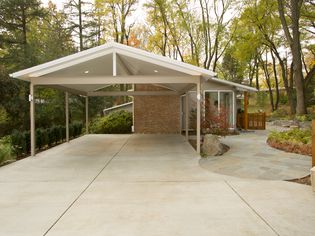
Custom-built carports are scratch-built, using wood or steel as the support structure and shingles, metal, or wood for the roof. These carports can be attached to the side of the house or left detached.
Designed as permanent structures, custom carports are cost-effective alternatives to traditional garages. Well-built carports can add to the property's value.
An attached custom carport uses one side of the house for support. This reduces the number of buried support posts required and also provides weather protection on one side.
Depending on the house's layout, an attached carport may allow you to walk directly into the home and remain protected from the weather.
Homeowners can have custom carports built to exact dimensions (subject to permitting), making them a good choice for irregularly sized or oversized lots or larger vehicles. Custom carports can accommodate any needs: extra-tall for RVs or long for boats.
Building a custom carport is best left to an experienced contractor. Permits are required, posts must be properly sunk in the ground, and zoning and setback restrictions must be observed.
Pre-Built Carport
Prebuilt carports are metal or wood frames covered with metal roofs. They are DIY-friendly for anyone with intermediate home improvement experience.
Pre-built carports are semi-permanent because they must be anchored to the ground but they don't require buried posts. The side rails can be anchored to concrete with expansion bolts or to gravel or dirt with long steel augers screwed into the ground and attached to the carport with steel cables.
Though usually open-sided, some pre-built carports have optional sidewalls to make them three-sided.
Single-bay carports capable of sheltering one vehicle are typically 10 or 12 feet wide, while double-wide carports are 20 feet wide. Most pre-built carports are seven feet high, though 14-foot-high carports can accommodate larger vehicles, boats, or RVs.
As with custom-built carports, pre-built carports are subject to permitting, inspections, setback restrictions, and plan reviews in most communities.
Pre-built carports cost around $1,700 to $2,000 for single-bay units and $2,500 to $3,000 for double-bay units.
Soft-Sided Carport
Soft-sided carports, like pre-built carports, are constructed on a metal framework. But soft-sided carports use UV-treated polyethylene fabric for the roof and sides.
These carports are anchored to the ground with stakes and lines, just like a tent.
While economical and easy to erect, soft-sided carports are not durable over the long-term. Wind storms, heavy snow, and hail can damage the fabric.
Soft-sided carports cost from $300 to $700.
Awnings and Shades
For vehicle owners on a budget, there are a number of unique alternatives like awnings and shades that mount quickly, provide limited protection to the vehicle, and are portable.
Retractable Awnings: Retractable awnings are installed on the side of the house for a narrow strip of vehicle protection that hugs the side of the house. Motorized or hand-crank retractable awnings cost from $500 to $1,500.
Sun Shades: Guy wires hold colorful sun shades aloft to block UV rays and debris. Sun shades do not block rain. As they are triangle-shaped, sun shades provide limited protection. So, use two or three shades to create a single, large array. Each shade costs $25 to $75.
Car Tents: A car tent or car umbrella is a waterproof polyester canopy that mounts on the car itself. The top is well-protected, but the sides are left open. Some car tents open electrically by a remote control. Car tents cost from $270 to $350.
Inflatable Car Covers: Protect your car by sealing it in a clear plastic bubble. A constantly running fan keeps the bubble inflated. Inflatable car covers cost from $500 to $1,000.
- Is it hard to build a carport?
Building a custom or pre-built carport is fairly difficult since both types of carports are permanent structures that require anchoring and permitting. A pre-built carport is easier to build than a custom carport because it can be anchored directly to the concrete or staked down, rather than requiring buried footers.
How close to the front boundary can I build a carport?Your community's land use code specifies minimum building setbacks for carports and garages. Lots are regulated by land use requirements to protect real estate values. So, speak with a planner in your about boundary setbacks. Pre-built carports typically have the same requirements as custom carports.
How deep do footings need to be for a carport?The depth of the footings for the carport is determined by local code and by the type of carport being installed. Some types of carports may need footings as deep as 48 inches. Pre-built carports that rest on concrete require expansion bolts embedded in the concrete.
Recommended Articles
 PAINTING
Paint Calculator: How Much Paint Do I Need?
This paint coverage calculator makes calculating the amount of paint you'll need for your project nearly automatic. Your role in the process involves just a few elements: Measure the height and width
SKILLS-AND-SPECIALTIESIs Your Dishwasher Not Turning On? 11 Ways to Fix It ASAP
Your dishwasher not turning on after you load it with filthy dishes is a major inconvenience. But wait —before you resort to unloading it and handwashing your dishes, try these troubleshooting methods
INTERIOR-REMODEL-AND-REPAIRWe Asked Real Estate Pros Their Best-Kept Secrets to Sell Your House Faster in 2025
When you've finally decided to sell your home, the process of doing so can be challenging and confusing. Whether it's going through numerous open houses or waiting around for the right offer (or any o
OUTDOOR-BUILDING15 Free Beehive Plans
Whether you're just getting started with beekeeping, or if you've already got established colonies, you may decide that building a beehive is for you. These beehive plans are a fairly straightforward
OUTDOOR-BUILDINGVeneer Stone vs. Natural Stone: Which to Buy and Install?
You may have seen beautiful displays of veneer stone or natural stone on the walls of homes or businesses. If you have a difficult time telling veneer stone apart from natural stone, that is entirely
EXTERIOR-REMODEL-AND-REPAIRStucco House Finish: Basics, Application, Pros, and Cons
Stucco is a durable, versatile exterior finishing plaster coat found on homes nationwide. Though fiber-cement panels, vinyl siding, and plywood are popular siding materials, stucco has been used for c
KITCHEN-REMODEL-AND-REPAIREssential Housewares & Appliances
Whether you're setting up a home for the first time or you're replacing lost items, this checklist of house essentials can help ensure you're covered for the basics. It can also come in handy when you
KITCHEN-REMODEL-AND-REPAIRKitchen Island Dimension Guide
When determining kitchen island dimensions, you'll need to consider many things, including its size, shape, and function. A properly sized kitchen island will not eat up too much space, impede kitchen