Perhaps you've seen the term duplex home used in a real estate listing or mentioned on a home remodeling show, but aren't quite sure what exactly it refers to. We're here to explain what it is, what this type of property's main features are, and what its advantages and disadvantages are so that you can decide whether this type of home is right for you.
In short, a duplex is one that's made up of two separate housing units that are attached. The two distinct units form one two-unit building that shares a common wall and may also share other outdoor spaces such as a driveway, front porch, or a backyard. Unlike a typical apartment building that may house multiple individual units, the term duplex exclusively refers to a building that consists of only two units.
Keep reading to learn more about this popular type of house.
Features of a Duplex Home
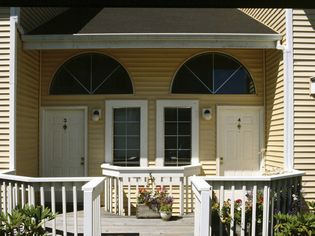
Often symmetrical in its exterior appearance, a duplex's main feature is a shared wall between two separate living units. The building has two separate entrances and typically features two garages—the two units are usually next to each other, although there are cases where the living units are one on top of the other.
You will sometimes see a single-level duplex that looks like two single-family homes that are attached, especially in suburban neighborhoods. In more urban areas, multi-level townhouse-style duplex homes are common as they take advantage of vertical space.
Besides a shared wall, the two units within a duplex sometimes share other areas as well. These can include a front porch, a driveway or parking lot, or a backyard that's open instead of being divided with a fence. The units generally share the same floor plan and their facade is identical on both unit exteriors for visual continuity.
Duplex vs. Triplex vs. Quadplex
A duplex has two separate units sharing a wall, a triplex has three units with one or more shared walls, and a quadplex has four units with one or more shared walls.
Differences Between a Duplex, an Apartment, and a Single-Family Home
In some ways, a duplex is a cross between an apartment and a single-family home. It is similar to an apartment in that your living unit is attached to another one, whether next to it or above or below it, however, a duplex building never has more than two units, which is not the case for an apartment building.
Unlike an apartment, it also offers outdoor space, which is where its similarities with a single-family home come in. It provides square footage closer to that of a single-family home, has its own entrance, and may have an attached garage.
A single-family home is a stand-alone residence occupied by one household. However, a single-family home may contain an accessory dwelling unit (ADU), a smaller, separate residential unit located on the same lot. An ADU can be a detached building or attached to a single-family home, either as an extension or as a separate internal section. Unlike duplexes, an ADU resident shares a mailing address and utilities with the single-family home. In some areas, ADUs cannot be rented or zoned to be a rental, so they often house extended family.
Pros and Cons of a Duplex
One of the main advantages of a duplex is the fact that it can be an excellent investment if you purchase both units and choose to rent one out, whether long-term or as a vacation rental. It can be a source of additional income as well as a way to help cover your own mortgage and build equity. Additionally, it can be a great way to accommodate multiple generations of a family on one large property, while each family unit has its own separate living space.
Another benefit that many home buyers appreciate about a unit in a duplex is the fact that it's less expensive than a single-family home. You get the majority of the benefits of owning a single-family home but at a lower cost. Keep in mind that a unit inside a duplex is generally smaller in size than a single-family home and you may have to share some outdoor areas with your neighbor or tenant.
A key disadvantage of a duplex is the potential noise level due to the shared wall. This, of course, depends on the occupants of the attached unit and the rooms that are affected by that shared wall. In some instances, the shared wall is located between the garages and non-bedroom spaces in order to minimize the noise level in both units.
You may be getting more space and privacy than you would be living in an apartment, but you will still have one neighbor. Some areas will still be shared and occasional seasonal maintenance responsibilities and costs may also need to be split between the owners of the two units. Another potential disadvantage of a unit in a duplex is the possibility of a lower resale value. It can be harder to sell than a single-family home because buyers can be nervous about having an immediate neighbor and not having complete privacy.
Is a Duplex a Suitable Choice for You?
A duplex is a great choice if you are looking for a property with income-generating potential since you can live in one unit and be in close proximity to the unit you rent out. It can also provide a place for a large, multi-generational family to live together while still enjoying their own space and privacy. If you're looking to transition out of an apartment or downsize from a larger home, don't mind sharing some common areas with your neighbor, and aren't too sensitive to potential noise, then a duplex may be a great new home for you.
- Is a duplex a townhouse?
A duplex is a two-unit building that is made up of two separate living units that share a common wall. Townhomes are rows of multi-floor homes that share two or more walls. Townhouses can also be confused with rowhouses. The main differences are that townhomes can have different styles within a row of townhomes, and they are built for a single family. Rowhouses are more uniform, have the same roofline, and may be broken into smaller apartments.
How many bedrooms are in a duplex?The number of bedrooms in a duplex varies, but they generally have anywhere between two and four bedrooms.
What is an advantage and a disadvantage of living in a duplex?One key advantage is the potential for an income property if you purchase both units. A commonly stated disadvantage is potential noise due to a shared wall between the two duplex units.
Are semi-detached dwellings considered duplexes?Both semi-detached homes and duplexes share one wall with another residence, but how ownership is structured makes them different. One homeowner owns a duplex, and one or both units may be rented. With semi-detached homes, each single-family residence is owned individually.
Recommended Articles
 SMALL-SPACES
15 Simple Small Living Room Ideas for Minimalist Style
Just because you have a small living room does not mean you have to skimp on style when it comes to decorating. Case in point, the following 15 simple small living rooms. Each one offers ideas for how
HOME-DESIGN-STYLESWhat Is Memphis Design?
Memphis Design is a striking postmodern style that began in the early 1980s with the innovative Memphis Design collective, led by renowned Italian designer Ettore Sottsass (1917-2007), and had an outs
INTERIOR-DECORATING4 Questions to Ask Yourself When You're Thrifting for Home Decor
I've been thrifting as long as I can remember, especially when it comes to sourcing fun and unique items for my home. It's always been exciting to go through various shelves to see what treasures I ca
ROOM-DESIGN-AND-DECORATING6 Popular Design Choices Designers Would Never Put in Their Own Homes
It's an interior designer's job to stay on top of the latest home trends. But it's not their job to love all of them. We asked three interior designers to dish the dirt on which popular design choices
INTERIOR-REMODEL-AND-REPAIRHow Long Does a Home Inspection Take? What to Know When Buying a Home
Home inspections are typically conducted during the selling process when a buyer wants to get an in-depth look at the property before investing. While home inspections are not required by most lenders
OUTDOOR-BUILDINGWhat Is a French Drain?
Heavy rain and melting snow can lead to water accumulating in the yard, where it forms puddles and creates large areas of mud and standing water. When water cannot drain away from the yard, it may flo
EXTERIOR-REMODEL-AND-REPAIRCan You Build on a Property or Utility Easement?
Easements can exist quietly on your property, not affecting you for years or decades. Then, when deciding to bump out your house, put on an addition, dig a pool, or erect a fence, you find a legal eas
BATHROOM-REMODEL-AND-REPAIRWhere You Should Save vs. Splurge on Your Bathroom Reno, According to Pros
If a new set of bath towels and cute wall decor haven't transformed your outdated bathroom as you had hoped, perhaps it’s time to consider a bigger makeover. If that triggers the sound of cash registe