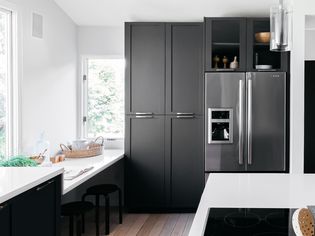
Counter-depth refrigerators are appliances designed to sit flush with the adjoining cabinetry and countertops. While standard-depth refrigerators jut out quite visibly from their surroundings, a counter-depth fridge can provide a more built-in look. If you are after sleek lines in your kitchen, keep reading to see if counter-depth refrigerator dimensions will work in your space.
What Is a Counter-Depth Refrigerator?
Refrigerators marketed as "counter-depth" typically have a basic box that measures between 23 and 27 inches deep, but the overall depth varies slightly from manufacturer to manufacturer. You may see refrigerators with overall depths of 28 3/4 inches (LG and Samsung), 30 3/4 inches (GE), or 27 1/2 inches (Whirlpool) all marketed as countertop-depth units. Despite the name, most counter-depth refrigerators will still stick out an inch or two beyond the cabinets once the doors are installed.
Counter-Depth vs. Standard-Depth Refrigerators
The Spruce / Michela Buttignol
Standard refrigerators are typically 30 to 36 inches deep or more. Countertops are normally about 25 inches deep (24 inches for the base cabinet with a one-inch overhang), so this means that a standard refrigerator will stick out from adjoining countertops by six inches or more. Depending on the model you are considering, a counter-depth refrigerator will come in at three to 13 inches less deep than standard-depth options.
A standard refrigerator is ideal if you need a narrower width, shorter height, or greater capacity. Counter-depth fridges offer a sleeker silhouette, but will often be taller or wider than their standard counterparts.
Benefits of Counter-Depth Refrigerators
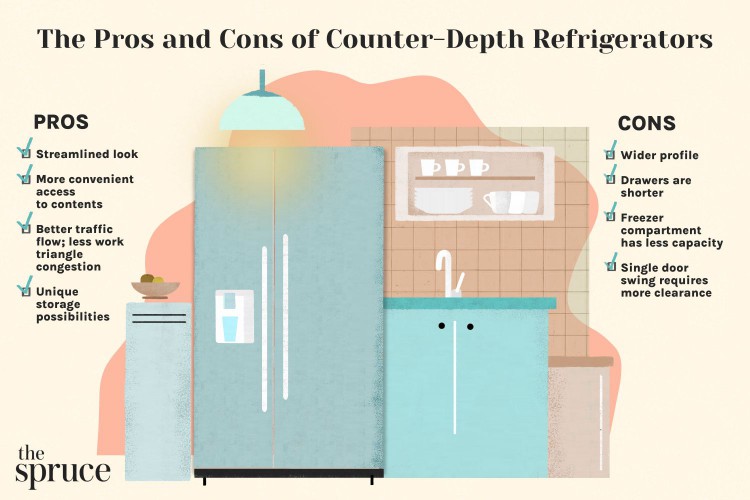
Counter-depth refrigerators can do wonders for your kitchen—here are a few pros to keep top of mind if you are purchasing a new refrigerator:
- More floor space: Counter-depth refrigerators sit closer to your cabinets, so you will have more room to move around your kitchen.
- Cleaner look: Visually, counter-depth refrigerators look more elegant and cohesive, since they feature a less-clunky silhouette.
- Unique dimensions: If you are likely to forget food pushed in the back of your fridge, or don’t mind reaching some higher-than-usual shelves, the dimensions of a counter-depth refrigerator could work better for your preferences.
Benefits of Standard-Depth Refrigerators
Standard-depth refrigerators have their own set of benefits, learn a few of them below:
- Greater capacity: Standard-depth fridges have deeper capacities and more space in the fridge and freezer sections in general.
- More extensive size range: Standard refrigerators generally come in more sizes, so you will have ample options to find the best model for you.
- Lower price point: While both options are available in an array of prices, standard-depth refrigerators tend to be less expensive than their counter-depth counterparts.
Counter-Depth vs. Built-In Refrigerators
phototropic / Getty Images
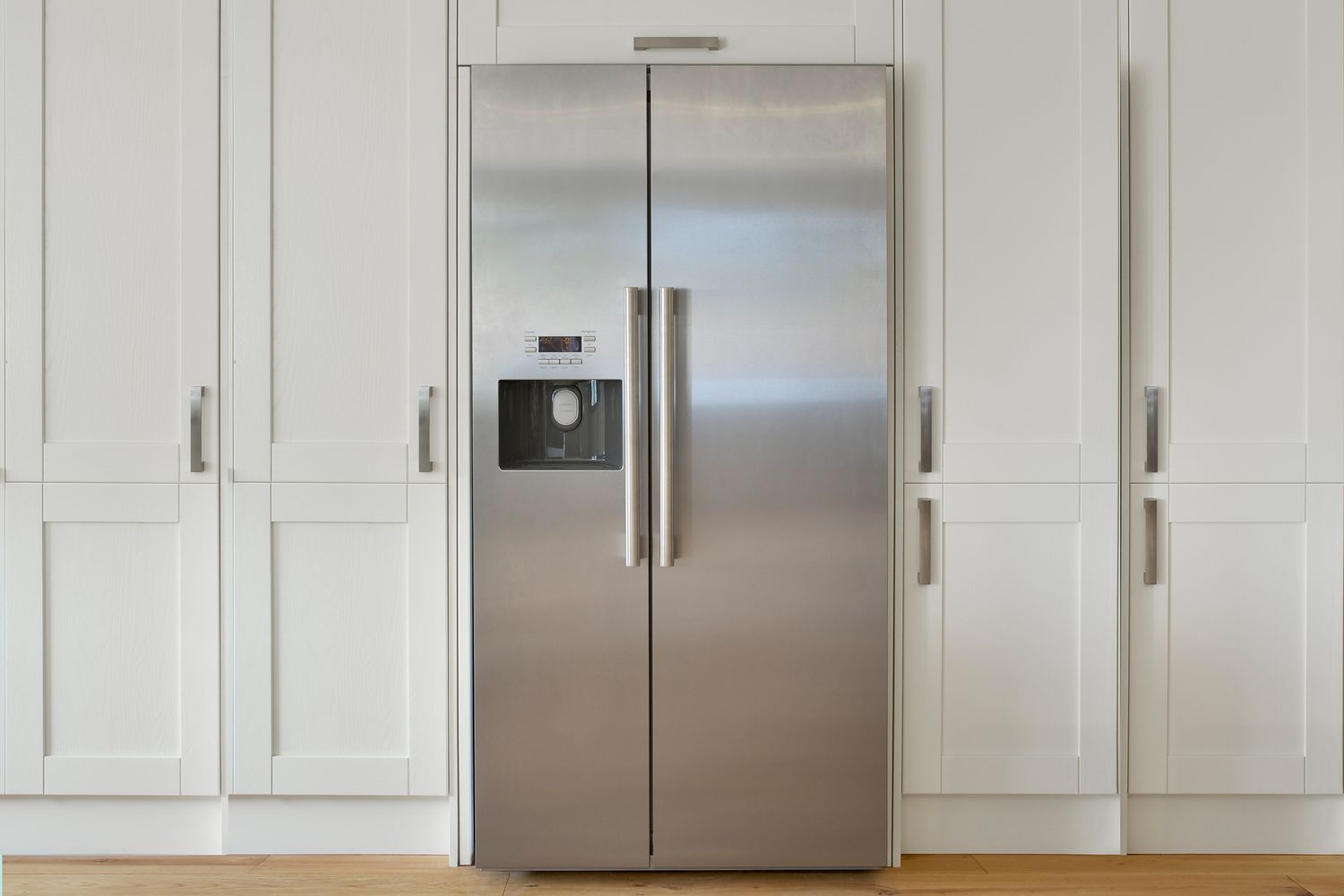
The difference between counter-depth and standard-depth refrigerator types is that counter-depth fridges are shallower and sit nearly even with your counters and cabinets. Standard-depth refrigerators, on the other hand, have an overall greater capacity but will jut out into the room more.
Measuring Tips for Counter-Depth Refrigerators
When choosing a refrigerator to match the depth of cabinets and countertops, keep the following issues in mind:
- Measure your specific countertops: Base cabinets are typically 24 inches deep, but you should always measure yours to be safe. The countertop overhang may add around 1 1/2 inches on some decorative treatments, and some backsplashes could push them forward even more. The front edge of a countertop could extend as much as 28 to 30 inches from the back wall.
- Expect overhang: While the box of a counter-depth refrigerator matches up to cabinetry and countertops, the doors will add a few inches. Typically, the overall depth when measured from back to front (including handles) is about 30 inches. Expect the refrigerator doors to extend forward from the front lip of standard countertops a bit so they have room to swing open.
- Read the manufacturer’s measurements: Sometimes, these numbers vary by as much as six inches. Some manufacturers measure the appliance depth to the edge of the box without the doors, some to the front of the door, and others to the front of door handles and hardware. Make sure you understand what dimensions are being referenced by the measurements.
- Leave room for gaps: Refrigerators may require a small gap between the back of the appliance and the wall. This will make the overall installed depth of the appliance slightly more than the actual dimensions.
- Note the backsplash: Built-up backsplashes can reduce the overall depth of the countertop; if there is no backsplash, you will need to account for extra depth when choosing a fridge. For reference, if cement-board backer and thick tile have been installed between the countertop and the base of the wall cabinets, the countertop depth may lessen as much as one inch.
- Know the capacity: Counter-depth fridges range in capacity from 15 cubic feet to 25 cubic feet. While a counter-depth fridge is space-saving, you will lose some of your total food storage capacity. While extra width and height can compensate for some lost space, most counter-depth refrigerators are slightly smaller in capacity than comparable standard models.
Understanding Manufacturer’s Dimensions
Most countertop-depth refrigerators will specify several depth dimensions, which you can interpret in whatever way fits your needs. For example, one KitchenAid counter-depth side-by-side refrigerator lists four different depth measurements:
- 21 3/4 inches: Depth to back of hinges. The box itself, nothing else. No doors, no handles.
- 26 7/8 inches: Depth with doors.
- 29 9/16 inches: Depth with doors and handles
- 23 3.4 inches: Depth without doors.
In a kitchen with standard kitchen cabinet dimensions (24-inch-deep base cabinets, covered with countertops with a one-inch overhang), you can expect the doors on a counter-depth refrigerator to extend past the front of the countertops. When measuring, allow for the two inches required for the doors to open and close freely.
- What is the shallowest refrigerator depth?
One of the most common shallow refrigerator depths is 24 inches, but some models can get as shallow as 21 inches.
Why do counter-depth refrigerators still stick out?Counter-depth refrigerators still stick out because they need a clearance of two inches or so to allow for the doors to properly open.
How much space is lost with a counter-depth refrigerator?Though you will likely lose some capacity, counter-depth refrigerators will be taller and wider to account for most of the lost storage space.
Are counter-depth refrigerators worth the cost?If your aesthetic is more design than function-based, then yes, a counter-depth refrigerator is worth the cost as it will add a sleek, streamlined look to your space. If your fridge requirements mean you need to utilize every inch of space, then counter-depth isn't for you.
Recommended Articles
 PAINTING
4 Natural Paint Removers for Every Surface
Removing or stripping paint from any type of surface is seldom an easy job. Every surface takes paint differently and every type of paint reacts differently to the surfaces. Add in environmental condi
SMALL-SPACES6 Ways to Make a Small House Feel Ten Times Larger, According to Designers
If you're a small space dweller, you know every square foot counts. And although it's impossible to actually make your home bigger without taking some major renovations, there are some key decorating
HOME-DESIGN-STYLESIs Farmhouse Design Out for 2025? We Asked Designers for Their Unfiltered Takes
As much as we love knowing what trends are on their way in, we also try to keep our eye on which trends are on their way out. From the segue away from cool gray to the fall of all-white kitchens, some
ROOM-DESIGN-AND-DECORATINGTips for a Better Concrete Garage Floor Slab
Whether you are just thinking about a new concrete garage floor or ready to start planning a new one, you probably have a lot of questions. Sure, you might be satisfied to call a concrete contractor a
HOME-IMPROVEMENT10 Best Basement Floors
Even when the weather is dry, basement flooring does not follow standard rules. Due to its proximity to the ground, it might leach residual moisture in vapor. Some basements can also experience up-to-
OUTDOOR-BUILDINGHow Much Does It Cost to Build a Barndominium?
Barndominiums are a type of home that combines living areas with workspace, often inside a restored barn or a new barn-like metal building. These unique structures are gaining popularity as alternativ
EXTERIOR-REMODEL-AND-REPAIRWinterizing Your House Now Can Save You Money Later—What Pros Want You to Know
The process of preparing your home for winter is known as winterizing, though the exact steps a homeowner needs to take to winterize their home varies. Basic winterizing tasks can be as simple as drai
KITCHEN-REMODEL-AND-REPAIRHow Much Does It Cost to Paint Kitchen Cabinets? A Complete Guide
Painting kitchen cabinets can be a cost-effective way to refresh your kitchen when the cabinets show signs of wear, such as fading or chipping. Rather than replacing the kitchen cabinets, which can be