Towel bars and other bathroom accessories should be located conveniently and at the correct height. The standard towel bar height is 48 inches to accommodate a comfortable reach for most adults. However, towel bars can be lower in children's bathrooms or in bathrooms for people with limited mobility. Read on to learn more about heights, locations, and dimensions for towel bars, rings, grab bars, soap dishes, toilet paper holders, and other bath accessories.
Towel Bar and Ring Heights
- Towel bars: Towel bars or towel racks should be 42 to 48 inches high.
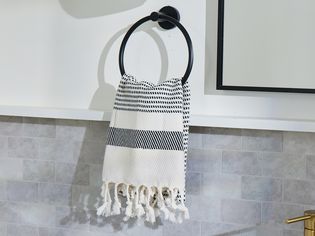
- Towel rings: Towel rings should be at least 20 inches above the vanity countertop.
- Above-toilet towel racks: Hotel-style towel racks (which incorporate towel bars and a top shelf and are usually installed above the toilet) should be at least 48 inches above the floor.
- Towel bar height in a children's bathroom: Place a towel bar between 36 and 48 inches up from the floor.
- Towel bar height for limited mobility: Place a towel bar 36 inches up from the floor for the easiest reach.
- Hand towel bar above vanity: Place a hand towel bar between 20 to 22 inches above the vanity's countertop.
Towel Bar and Ring Locations
Towel bars and other towel hardware should be within easy arm's reach near each sink and bath fixture.
Bars usually work best on the longest wall in the bathroom and should be as long (horizontally) as possible. Towel and robe hooks can be used alone or in groups and fit more easily on short walls than towel bars.
The Spruce / Jacob Fox
Bathroom Accessory Heights
- Towel or robe hook: Towel or robe hooks should be 70 inches above the floor. Multiple hooks should be spaced a minimum of 9 inches apart.
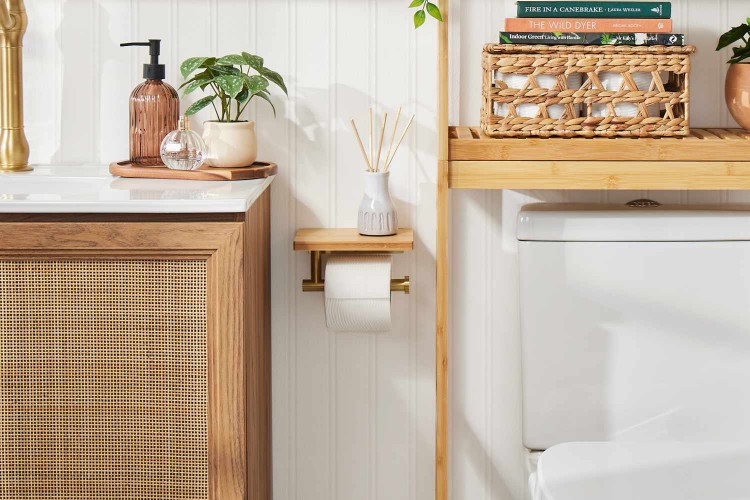
- Toilet paper holder: The ideal toilet paper holder height is 26 inches, but you can install it anywhere between 15 and 48 inches from the floor. The holder should be 8 to 12 inches in front of the front edge of the toilet, measured to the center of the holder.
- Shower soap dish: Soap dishes should be installed between 44 and 54 inches above the shower or tub floor. A soap dispenser should be installed 40 to 48 inches above the floor, and the dispenser's push button should be no more than 44 inches above the floor.
The Spruce / Jacob Fox
Mirror Height
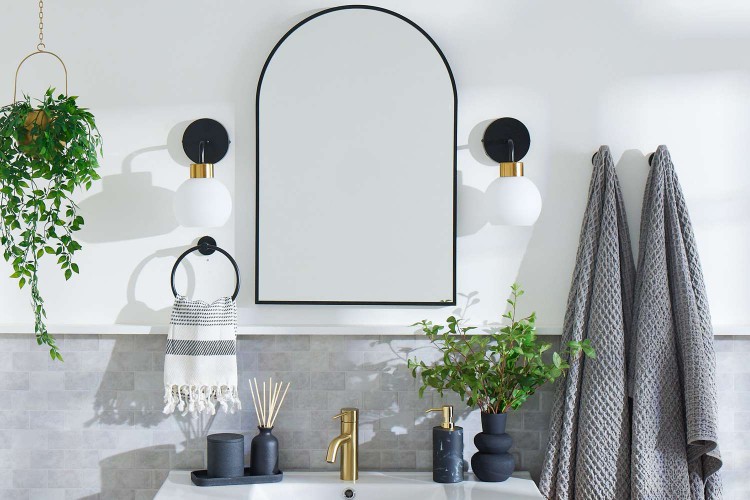
Mirrors can be installed between 38 and 42 inches above the finished floor, measured to the bottom edge of the mirror. Mirrors are typically centered over sinks or vanity countertops. In this case, the bottom edge of the mirror should clear the top of the bathroom counter by at least 4 inches.
Mirrors can be installed between 38 and 42 inches above the finished floor, measured to the bottom edge of the mirror.
Mirrors are typically centered over sinks or vanity countertops. In this case, the bottom edge of the mirror should clear the top of the bathroom counter by at least 4 inches.
The Spruce / Jacob Fox
Wall Cabinet Height
Bathroom wall cabinets are normally installed 54 inches above the floor. This provides 18 inches of clearance above a standard 36-inch-tall vanity (with a countertop).
A minimum of 18 inches of clear space above the bathroom vanity is recommended. But cabinet height can vary with different vanity heights, as needed.
Grab Bar Heights
Toilet Grab Bars
- Toilets—side wall: According to ADA requirements, each toilet needs a grab bar that is at least 42 inches long installed horizontally on the side wall nearest the toilet; this should be located 12 inches at most from the rear wall (behind the toilet).
- Toilets—rear wall: With toilets, the rear wall should have a 36-inch grab bar centered over the toilet tank (a 24-inch grab bar is acceptable if space is limited).
Bathtub Grab Bars
- Bathtubs without permanent seats: The back wall needs two grab bars, each at least 24 inches long. The upper bar should be 33 to 36 inches above the floor; the lower bar should be 8 to 10 inches above the tub rim. Both bars may be no more than 12 inches from the foot-end wall and 24 inches from the head-end wall. The foot-end wall needs a 24-inch (minimum) bar starting at the tub's front edge. The head-end wall needs a 12-inch (minimum) bar starting at the tub edge. Additionally, the end wall bars should be 33 to 36 inches above the floor.
- Bathtubs with permanent seats: The back wall needs two bars, one 33 to 36 inches above the floor and one 8 to 10 inches above the tub rim. The bars may be no more than 12 inches from the foot-end wall and 15 inches from the head-end wall. The foot-end wall needs a 24-inch (minimum) bar starting at the front edge of the tub.
Shower Grab Bars
- Roll-in shower: Each wall needs a bar 33 to 36 inches above the floor and no more than 6 inches from the adjacent wall. A bar is not required on a wall with a seat.
- Transfer shower: A continuous or wraparound bar must be installed along the control (faucet) wall and extending at least 18 inches along the back wall, at a height of 33 to 36 inches above the floor.
- How close to the shower should a towel bar be?
The towel bar should be within easy arm's reach to the shower to prevent slips. Generally, this distance is 1 to 2 feet from the shower.
If hanging two towel bars stacked, how far apart should they be?Two stacked towel bars should be about 31 inches apart vertically, assuming that your bathroom towels are the standard size of 54 inches long.
Should a towel bar be hung above the toilet?Hanging a towel bar over a toilet isn't ideal since the towel must clear the toilet tank. Most toilet tanks are about 29 inches high. However, if necessary, it's acceptable to hang a towel bar over the toilet.
What is the standard ADA height for towel bars?The standard ADA height for towel bars is 48 inches from the floor, the same as a standard height requirement. However, the towel bar can be placed as low as 36 inches up from the floor to accommodate individuals with limited mobility.
Recommended Articles
 INTERIOR-REMODEL-AND-REPAIR
4 Budget-Friendly Tips to Know Before Renovating Your Home, According to Home Experts
This story is a part of our Old House New Issue, where we explore why people are no longer moving in 2024, and how to renovate your current home to make it work for you. To learn more about where to s
INTERIOR-REMODEL-AND-REPAIRCan You Tile Over Tile? 4 Things You Should Know Before Tackling This Project
If your home can support excess weight and the existing tiles are in good condition, you can consider tiling over tile. You should tile over tile to save time and money and it can also be an eco-frien
HOME-IMPROVEMENTElectrical Code Requirements for Outlets in the Home
An electrical code is an official set of guidelines that specifies how various aspects of an electrical system should be installed. Most local residential electrical codes are based on the NEC—the Nat
HOME-IMPROVEMENTHow to Use Cement Backer Board
Cement backer board is an inexpensive, convenient building material that makes tiling, flooring, and countertop projects go faster and look better in the end. Most importantly, cement backer board co
HOME-IMPROVEMENTSubflooring vs Joists vs Underlayment: What's the Difference?
Layered flooring systems are flexible, sturdy, inexpensive, and easy to build. The flooring system found in most homes starts with a floor covering (laminate, vinyl, tile, or other) on top of an optio
EXTERIOR-REMODEL-AND-REPAIR8 Surprising Things You Can Actually Clean With a Pressure Washer, According to an Expert
Pressure washers can't be used to clean everything, but they can be useful tools.Driveways, sidewalks, decks, patios, and fencing can all be cleaned with a pressure washer.Pools, artificial turf, tras
KITCHEN-REMODEL-AND-REPAIR7 Best Backsplash Materials
Similar to choosing tiles for the shower or hardwood for the floor, it's important to take your time selecting a kitchen backsplash material because it will be a permanent part of your kitchen decor—a
KITCHEN-REMODEL-AND-REPAIRHow to Get Rid of Garbage Disposal Smells
A garbage disposal is a quick method for removing certain food wastes, but they may leave behind unpleasant smells. Some foods, like eggshells, grease, and oil can't go in the garbage disposal because