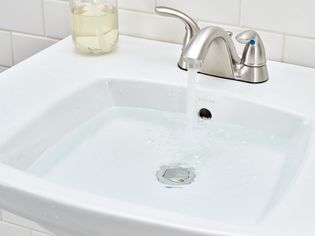
Bathroom sinks and some other fixtures include a sink overflow hole, or multiple holes, in the basin. This opening is either located near the top of the basin wall nearest to you or right under the faucet on the opposite basin wall. The overflow opening serves two important functions:
- If the water tap is left on while the drain stopper is closed, the opening will channel water down into the drain opening rather than letting it spill out of the sink onto the floor.
- The overflow allows the sink to drain faster by introducing air into the system.
How the Sink Overflow Works
A standard sink overflow is a hidden channel running along the underside of the sink basin. You may not be able to see it from the top of the sink and often can't see it from below, either. At the top of the overflow channel, there will be one or two holes near the rim of the basin. The bottom of the channel has an outlet hole that lets water flow into the drain just below the basin. The basin and the overflow empty into the same drain pipe, but the overflow is always open and isn't affected by the sink stopper.
How to Clean a Sink Overflow Hole
To ensure that a sink overflow can serve its purposes, it needs to stay clean and free of debris. Gunk can build up near the bottom of the overflow channel, restricting the flow of water and air. And since an overflow usually doesn't get flushed out unless the sink is overflowing, the channel doesn't get a regular cleaning. There are several ways to manually clean the overflow and keep the sink draining properly:
- Pipe cleaner or sink-cleaning brush: Put the pipe cleaner or sink-cleaning brush into the sink overflow hole, swirl it around, and push the brush in and out to dislodge the gunk. Do this slowly or the brush can cause the gunk to spray all over the basin. Take it a step further and use a flexible heat-resistant funnel to pour hot or boiling water into the hole to flush it out. This can be messy and you may need to reclean your sink basin.
- Zip tie: Long plastic zip ties work very well because they bend around the curve of the sink but are rigid enough to dislodge any buildup. Insert the pointy end of the zip tie into the overflow opening and slowly work it down as far as possible. Move the zip tie up and down and side to side to loosen and push out any blockage. Be careful not to drop the zip tie into the overflow tube—a longer zip tie will be easier to hold.
- Rubber hose: Fill up the sink with water slightly higher than the overflow opening. Let some of the water run down the overflow. Put one end of the rubber hose against the overflow opening and blow several puffs of air through the other end. Drain the sink and blow air through the hose again. The air should blow through freely, without resistance. Repeat as needed. A 7/8-inch dishwasher hose works well for this, but any sturdy hose can work as long as it fits over the overflow opening.
- Liquid cleaner: Create a 50/50 mixture of chlorine bleach and plain water and pour the mixture down the overflow hole(s), using a container with a pour spout. Let the mixture sit for 10 minutes, then flush the overflow with plain water.
Warning
Do not use bleach if your home has a septic system; instead, use a commercial enzyme drain cleaner that is safe for septic systems. Mix the product as directed and pour it into the overflow hole(s). Let it sit overnight, then flush the overflow with water.
How to Clean a Sink Overflow Hole if It Stinks
Your sink overflow hole may have a stench because there's a build-up of mildew sitting in there. It's easy to clean using a couple of simple ingredients.
- 1 cup baking soda
- 1 cup distilled white vinegar
- 2 quarts boiling water
- A funnel made of heat-resistant material (metal or silicone)
Put the funnel in the sink overflow hole and pour baking soda into it followed by the vinegar. Let the fizzing action do its job in the overflow hole for about 15 to 20 minutes. Flush the hole with boiling water using the funnel. Repeat this process until the smell is gone.
Main Functions of Overflow Holes
Function 1: Preventing Water From Overflowing
If you close the drain of your bathroom sink and fill up the sink basin to the level of the overflow hole, the water will begin draining into the overflow opening and down the drain. This helps prevent the water from spilling over the top of the basin, but because sink overflow holes are usually small, they may not prevent an overflow for very long. If the faucet is running at full volume, the overflow tube may just delay water from overflowing for a short time.
It's a common misconception that the sink overflow prevents overflowing water if the sink drain is clogged. However, the overflow outlet on most sinks is very close to the drain opening in the basin, and it's unlikely that a clog can occur between the drain opening and the overflow outlet so that it clogs up the drain but not the overflow hole. A bathroom sink overflow really protects against overflow when the stopper is closed and the faucet is accidentally left running, not in the event of clogs.
Overflow drains on bathtubs are a bit different and have more distance between the drain opening and the overflow connection. The overflow fitting on a tub can still work to prevent water from overflowing if a clog is close to the tub drain opening.
Function 2: Improving Drainage
The sink overflow helps the basin drain faster by allowing air into the drain pipe via the overflow channel. When there's enough water in the basin to completely cover the drain opening, the drain can't get air through the water, creating a suction effect that slows the flow of water going down the drain. But with the overflow feeding air to the drain pipe, the suction effect is reduced and the water drains much faster. By contrast, sinks that don't have overflow openings commonly send up bubbles as they drain, and they typically drain more slowly.
- Does a sink need an overflow hole?
A bathroom sink should have an overflow hole for functionality though it is not mandatory. Kitchen sinks do not typically have overflow holes since the basins and drain pipes are larger than they are in bathrooms.
Why is water coming out of my sink's overflow hole?You probably have a clog or obstruction somewhere in your drain pipe. Start by cleaning the P-trap of your bathroom sink. If that doesn't help, remove your sink stopper and snake the bathroom sink. The problem may require a plumber.
Where does a sink overflow hole drain to?The sink overflow hole drains into the drain pipe in your bathroom.
Recommended Articles
 FENG-SHUI
Feng Shui Tips for Your Tiny Apartment
Tiny spaces like studio apartments may seem like they would be hard to apply feng shui. But fear not! Small living spaces can also have good feng shui. Here are our top feng shui tips for your tiny ap
INTERIOR-DECORATINGGuide to Common Fabric Patterns and Types
It's a common scenario: You're on the hunt for fabric swatches and can envision the exact fabric pattern you want, and it's stuck at the tip of your tongue. There are hundreds of fabric patterns and t
INTERIOR-DECORATING6 Budget-Friendly Summer Decorating Tips You Shouldn't Overlook, Designers Say
The summer season is finally here, and with that, you may be looking for some clever ways to amp up your decor in honor of these warmer months. Whether you're hoping to address the inside of your home
INTERIOR-REMODEL-AND-REPAIRDreaming of a New Fireplace This Winter? 4 Types You Should Know and How to Choose One
Whether you're redoing an existing fireplace or adding an entirely new fireplace to your home, you may be caught off guard by the numerous types of fireplaces you can choose from. The four common type
HOME-IMPROVEMENTCalculating Electrical Load Capacity for a Home
Electrical capacity isn't something you need to think about on a day-to-day basis, but it becomes important when planning upgrades, looking for new appliances, and installing kitchen or laundry essent
HOME-IMPROVEMENTNational Electrical Code (NEC) Rules for Outdoor Wiring
The National Electrical Code (NEC) includes many specific requirements for installation of outdoor circuits and equipment. With outdoor wiring, the primary safety concerns involve shielding against mo
HOME-IMPROVEMENTHow to Pull Off a Live-in Renovation
Let’s face it: undergoing a renovation while living at home is no easy feat. Of course, it’s exciting to finally see your space as you envision it. However, there are the inevitable loud noises, lengt
OUTDOOR-BUILDINGWhat Is a French Drain?
Heavy rain and melting snow can lead to water accumulating in the yard, where it forms puddles and creates large areas of mud and standing water. When water cannot drain away from the yard, it may flo