Mortar bonds bricks or other masonry units and strengthens walls and other structures. Type S mortar mix, in particular, is load-bearing and performs extremely well to withstand pressure from soil, wind, and seismic loads.
However, there are other types of mortar mixes—types N, O, and M—that are mixed with different ratios of cement, lime, and sand to produce specific performance characteristics, emphasizing flexibility, bonding properties, and compressive strength. The best mortar types and their use depend on the application and the design specifications for the project.
Types of Mortar
Types of mortars are generally categorized into lime mortars, cement mortars, and specific types like S, N, O, M, and K types. Each type is composed differently, each with varying strengths and applications.
Types of Mortar by Composition
Mortars have different compositions that create the paste-like mixtures used for different applications vs. S, N, O, M, and K types made with varying parts of cement and sand. Here are some types of mortar by composition:
- Lime mortar: This mortar type is not used anymore because Portland cement is more common.
- Cement mortar: Cement mortar is a basic mix of cement, sand, and water. Aerated cement mortar adds a foaming agent to create a lighter, thermal, and acoustic insulation material used for building materials.
- Surkhi mortar: This mortar's sand is replaced with finely powdered burnt clay and used for water-resistant building applications.
- Gauged mortar: The formulation of cement, lime, and sand allows for movement and is used for various masonry (bricklaying, foundations, repairs) for sensitive historic buildings.
- Thin-set mortar: This thinner mortar, composed of cement, sand, and water, is used for tile but is not fit for use with heavier bricks or stones.
- Mud mortar: Mud replaces lime in this lower-cost mortar. It is used to bind building products, like stones, bricks, or tiles.
- Epoxy mortar: This newer mortar type is waterproof, stain-resistant, consists of epoxy resins and solvents, cures fast, and is preferred for use in tile work.
- Gypsum mortar: This type of mortar, made from gypsum, sand, and water, is used to plaster walls and ceilings because it's smooth to apply and fast-setting.
- Packing mortar: This is another commercially used mortar that usually combines cement, sand, and loam. It is extremely strong, and many oil wells are built with this type of mortar.
- Specialty mortar: If you're working on a project such as a fire pit, fireplace, or chimney, you will need to use a special high-heat mortar, also known as refractory mortar, which is formulated to handle high temperatures. Chemical-resistant mortar is another specialty type formulated to withstand exposure to harsh and corrosive chemicals.
- Heavy- and lightweight mortar: These mortars use heavy- or light-density aggregates for special applications. Heavy-weight mortar can be used for commercial areas where radiation reduction is necessary. Lightweight mortar is used for soundproofing and thermal applications.
Type S Mortar Mix
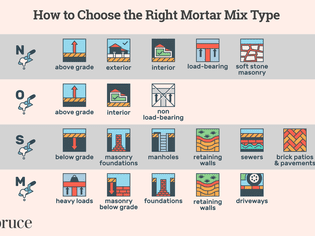
Type S mortar is the common choice for many below-grade applications, such as the following:
- Masonry foundations
- Manholes
- Retaining walls
- Sewers
- At-grade projects like brick patios and walkways
Type S mortar mix offers high compressive strength of over 1,800 psi and high-tensile bond strength. It is a load-bearing mix that withstands pressure from the structure that it is bearing, as well as pressure from soil, wind, and seismic loads.
The most common ratio formula for Type S mortar is two parts Portland cement, one part hydrated lime, and nine parts sand. It can be mixed at different ratios for strengths reaching 2,300 and 3,000 psi. Lime gives type S its water-resistant properties, as opposed to mortar mixes with lower ratios of lime.
Type N Mortar Mix
Type N is the mortar most often used by homeowners and is the best choice for general applications. Type N mortar mix is useful for the following:
- Above-grade walls (including stone veneer), exterior applications exposed to severe weather and high heat
- Interior load-bearing installations
- Soft stone masonry (such as limestone)
Type N mortar mix has a medium compressive strength and is composed of one part Portland cement, one part lime, and six parts sand. It typically achieves 750 pounds per square inch (psi) strength within 28 days.
Type O Mortar Mix
Type O mortar mix has relatively low compressive strength (at about 350 psi) As such, it is used primarily for interior, above-grade, non-load–bearing walls.
Type O mortar mix can be used as an alternative to Type N for some interior applications, but its exterior use is limited due to its low structural capacity.
Type O mortar mix is not recommended in areas subjected to high winds. However, type O mortar mix is ideal for repointing and similar repair work on existing structures, due to its consistency and ease of application.
Type M Mortar Mix
Type M mortar mix has the highest amount of Portland cement and is recommended for heavy loads and below-grade applications, such as:
- Building foundations
- Retaining walls
- Driveways
While type M mortar provides at least 2,500 psi of compressive strength, it offers relatively poor adhesion and sealing properties, making it unsuitable for many exposed applications. Type M is preferred for use with natural stone because it offers similar strength to that of stone.
Type K Mortar Mix
Type K mortar is rarely used for new construction. Because of its softness, type K is primarily used for restoring the masonry on historic or ancient buildings that require a special mix that is not significantly stronger than the existing masonry. It offers a very low compressive strength of only about 75 psi.
- Which type of mortar is the strongest?
The strongest type of mortar is type M mortar mix. This mortar contains the most cement in its ratio, making it ideal for heavy applications like foundations and retaining walls.
Is thinset mortar as strong as concrete?Though both thinset and concrete contain cement, thinset mortar is not as strong as concrete. Thinset bonds to tile, and has a less compressive strength compared to concrete. Concrete is used for structural projects.
Does adding lime to a mortar mix make the mortar stronger?Yes, adding lime to mortar makes the mortar crack-resistant. Lime expands when it becomes hydrated, which adds to its strength.
Recommended Articles
 PAINTING
Paint Calculator: How Much Paint Do I Need?
This paint coverage calculator makes calculating the amount of paint you'll need for your project nearly automatic. Your role in the process involves just a few elements: Measure the height and width
INTERIOR-DECORATINGWhat Carpet Is Best for Stairs?
Choosing the best carpet for stairs can be tricky because it has to have the appropriate durability and thickness for the job. It also has to look good as it is cut, wrapped, and tucked around the edg
ROOM-DESIGN-AND-DECORATING6 Things That Are Secretly Making Your Countertops Look Bad, According to Design Pros
Key Points Store small appliances, spices, and paper towels off the counter to reduce visual clutter.Keep junk mail and schoolwork in drawers or wall organizers, not on your kitchen surface.Use hooks
INTERIOR-REMODEL-AND-REPAIR5 Lessons I Wish I Learned Earlier About Renovating a Home as a First-Time Homeowner
This story is a part of our Old House New Issue, where we explore why people are no longer moving in 2024, and how to renovate your current home to make it work for you. To learn more about where to s
HOME-IMPROVEMENTElectrical Code Requirements for Outlets in the Home
An electrical code is an official set of guidelines that specifies how various aspects of an electrical system should be installed. Most local residential electrical codes are based on the NEC—the Nat
EXTERIOR-REMODEL-AND-REPAIRStucco House Finish: Basics, Application, Pros, and Cons
Stucco is a durable, versatile exterior finishing plaster coat found on homes nationwide. Though fiber-cement panels, vinyl siding, and plywood are popular siding materials, stucco has been used for c
BATHROOM-REMODEL-AND-REPAIRComprehensive Guide to Remodeling a Small Bathroom
Homeowners often imagine that remodeling a small bathroom—about 50 square feet or less—will be much quicker, easier, and less expensive than remodeling a large bathroom. The reality is you may not sha
KITCHEN-REMODEL-AND-REPAIRIs This the Year You Switch to an Induction Cooktop? Here’s What You Should Know
Induction cooktops look nearly identical to standard smooth-top ranges but there's much more to them than meets the eye. Functionally, there's a big difference between induction cooktops and ordinary