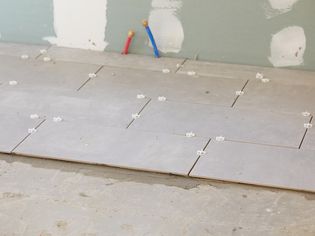
Layered flooring systems are flexible, sturdy, inexpensive, and easy to build. The flooring system found in most homes starts with a floor covering (laminate, vinyl, tile, or other) on top of an optional buffering underlayment. The floor covering and underlayment rest on a thick, solid subfloor supported by sturdy joists.
Learn the differences between subflooring, joists, and underlayment, as well as their roles below floor coverings such as wood, tile, laminate, or vinyl.
The Spruce / Margot Cavin
The Spruce / Margot Cavin
| Material | Vertical Position | Purpose | Required? |
| Floor covering | 1 | Top visual/walking layer | Yes |
| Underlayment | 2 | Optional buffer | No |
| Subfloor | 3 | Solid flat base | Yes |
| Joists | 4 | Main superstructure | Yes |
Floor Covering
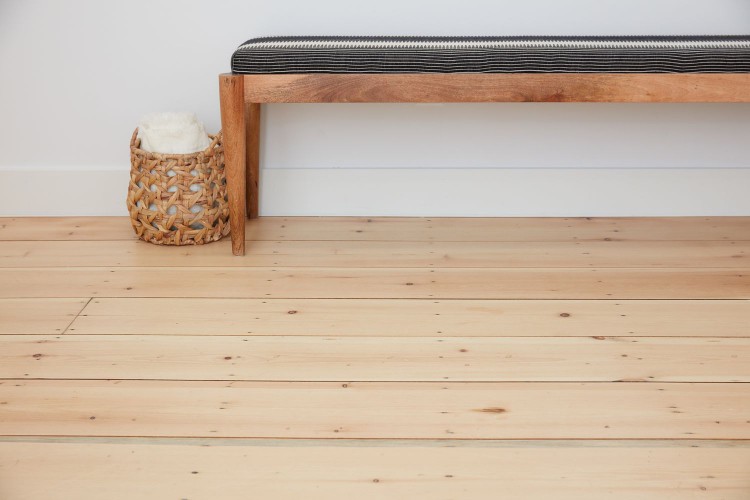
Floor covering is the topmost layer that you see and walk on such as ceramic tile, solid wood, laminate, engineered wood, luxury vinyl, or carpeting. Floor covering is not structural, so it will always have a subfloor under it.
The Spruce / Margot Cavin
Underlayment
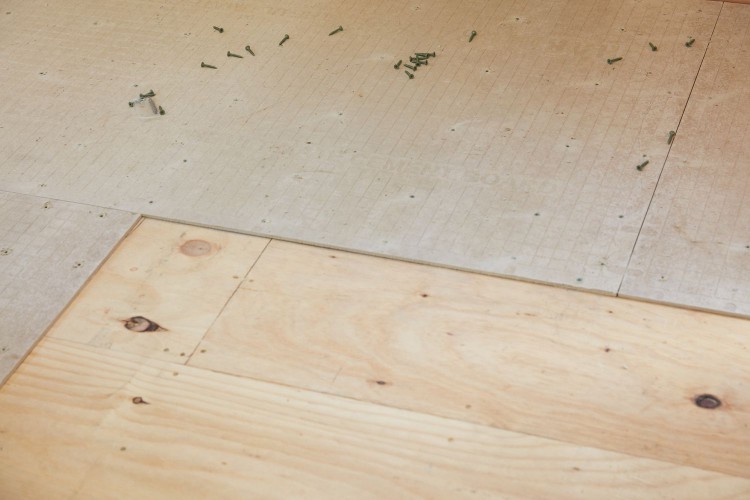
Underlayment is the optional thin buffer between the floor covering and the subflooring.
Underlayment is not required in all installations, and it can have different meanings, such as:
- Wood: Thin luan or plywood that smooths uneven subflooring for solid hardwood or engineered wood flooring.
- Backer board: Cement backer board for tile and stone flooring.
- Laminate underlayment: Thin foam or felt installed under laminate flooring.
The Spruce / Margot Cavin
Subfloor
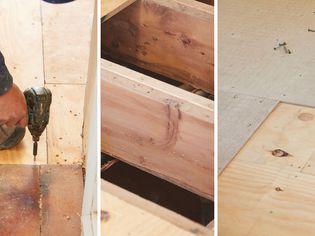
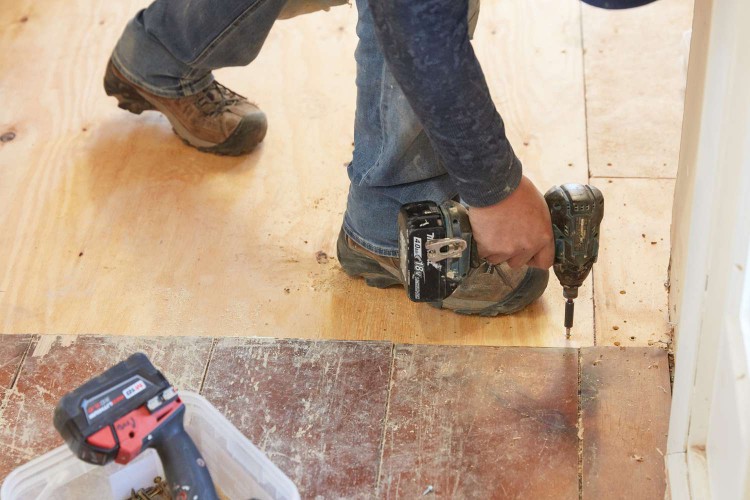
The subfloor is the flat, stable surface below the floor covering. The subfloor is nailed to the top of the joists.
Most houses have subfloors. The subfloor is typically made of plywood or OSB, ranging from 19/32 inches to 1-1/8 inches thick. Subfloor plywood or OSB sheets typically have tongue-and-groove edges to reduce floor sagging and bounce.
If the bottom-most floor is a concrete slab, its definition as a subfloor becomes more fluid. The concrete can be painted or left uncoated and used as-is. Or a subfloor system can be built on top of it to separate a floor covering (like carpeting or laminate) from the concrete. A third option is to install an uncoupling membrane like Schluter Ditra on the concrete and then install ceramic tile on top of the membrane.
The Spruce / Margot Cavin
Joists
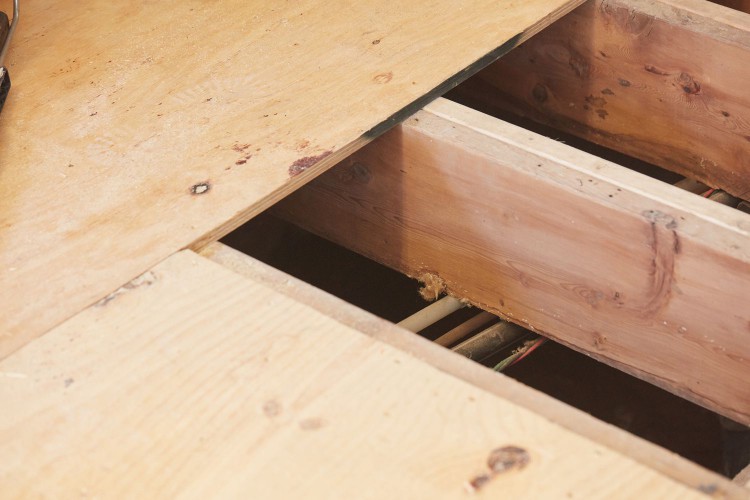
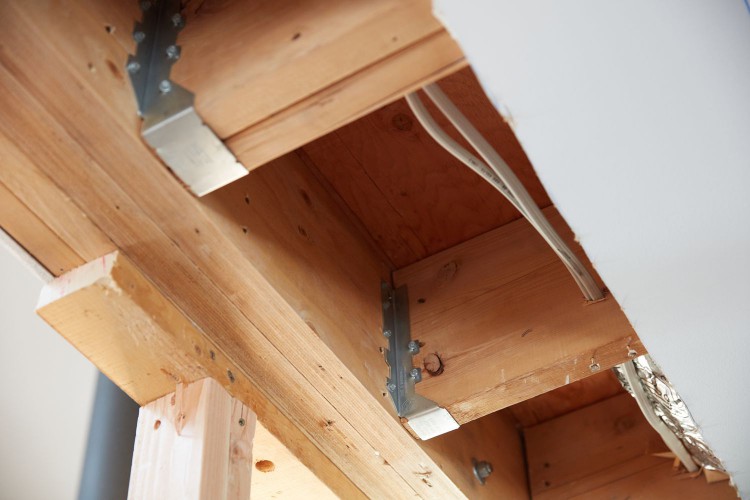
Joists form the bottom-most superstructure of the flooring system.
Made of engineered wood, laminated wood, or dimensional lumber, joists are arranged parallel to each other and typically 16 inches apart, though this spacing may vary. If the home has a concrete slab floor, it will not have joists.
The Spruce / Margot Cavin
How to Determine Flooring Type and Thickness
You may need to determine the number of layers of flooring materials and the floor's total thickness. You will need a straight-edge ruler or a tape measure to do this.
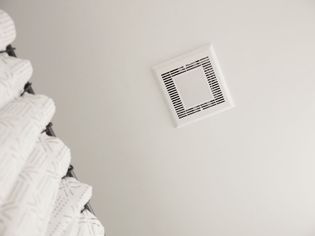
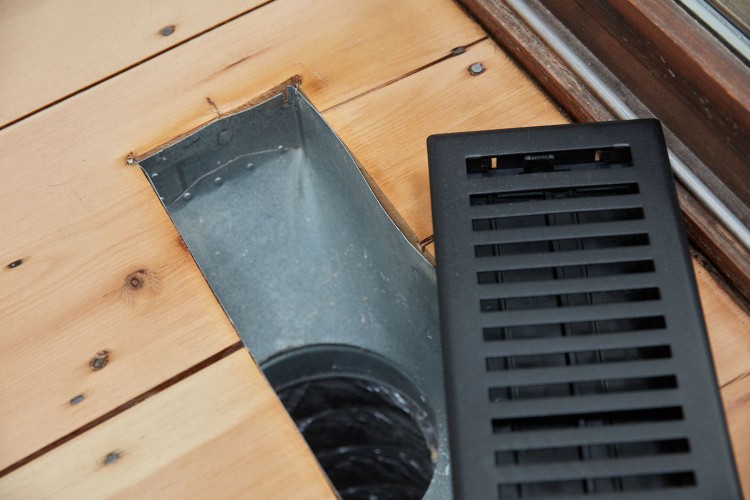
- Floor heating vent: Remove a floor HVAC vent by lifting it straight up. With the vent removed, you have a wide, clear view of a cross-section of your floor.
- Top of stairs: Sometimes, the top of a staircase has an unfinished opening that permits a cross-section view of the entire floor. Even if the stairs are fully finished, you can get an approximate thickness reading by measuring the distance from the top of the riser to the top of the floor covering.
- Basement and crawlspaces: This method might give you a rough idea of the layers if the basement's ceiling and joists are exposed. Reach up and try inserting a straight edge or tape measure up through any space or gap you find between the subfloor panels and take note of the measurement.
- Unfinished areas: If an unfinished area like a closet or pantry lacks baseboard molding, place the straight edge along the wall. Slide it down until it touches the subfloor to measure the thickness of the floor covering and any underlayments.
The Spruce / Margot Cavin
- Which is better to use as a subfloor, plywood or OSB?
Plywood is a stronger subfloor material and performs better than OSB if it gets wet. OSB tends to swell up if it gets flooded, and it does not return to its original dimensions after it has dried out. However, from a cost perspective, OSB is better than plywood since it's about half the cost of plywood.
When should I use underlayment over a subfloor?Underlayment is not a substitute for subfloor. Subfloor is a thick, stable base for the floor covering (like carpeting), and the subfloor rests on top of the joists. Underlayment, if required, is a thin buffer that rests on top of the subfloor. Underlayment is never installed directly on the flooring joists.
What type of subfloor is the most budget-friendly?OSB subfloor is the most budget-friendly subfloor material. One sheet of 23/32-inch OSB subfloor costs about $20 per 4-foot by 8-foot panel. A comparably sized sheet of plywood subfloor panel costs $40. So, plywood costs twice as much as OSB subfloor.
Recommended Articles
 INTERIOR-DECORATING
I Don't Care That I'm Renting — 7 Big Changes I'm Making to My New Apartment
After a year of sublets and crashing with my sister, I'm bordering on desperate to make my newly rented apartment feel like home. I have a limited set of tools, a passion for reading instructions thor
INTERIOR-REMODEL-AND-REPAIR8 Home Upgrades You Can Finally Check Off Your List, Based on Your Tax Refund
The average tax return for Americans ranges from about $2,000 to $3,500, which is a sizable amount of money. In fact, it can even be enough to invest into your home where even a relatively small budge
HOME-IMPROVEMENTStanding Seam Metal Roofing: Know Before You Buy
For a long time, your main option for roofing materials was asphalt shingles. Most metal roofs were confined to commercial buildings or to higher-end residential structures. Now, standing seam metal r
OUTDOOR-BUILDINGHow Much Does It Cost to Build a Barndominium?
Barndominiums are a type of home that combines living areas with workspace, often inside a restored barn or a new barn-like metal building. These unique structures are gaining popularity as alternativ
EXTERIOR-REMODEL-AND-REPAIRHow Much Does a Home Addition Cost?
Building a home addition is the ultimate way to add large amounts of fully usable space to your home and enhance its resale value. The average cost to build a home addition is $50,000; typically, cost
BATHROOM-REMODEL-AND-REPAIRHow to Choose a Bathroom Exhaust Fan
Bathroom exhaust fans are required by the NEC (National Electrical Code) and local building codes for any bathroom that doesn't have a window that can be opened to provide ventilation. In some jurisdi
KITCHEN-REMODEL-AND-REPAIR4 Inexpensive Options for Kitchen Flooring
You can easily spend $20 to $30 per square foot on luxury flooring for your kitchen, but if you are willing to shop around and tackle the installation yourself, a new kitchen floor can cost well under
KITCHEN-REMODEL-AND-REPAIR7 Types of Stoves and How to Choose One for Your Home
To choose the right type of stove for your kitchen, combine a stove style that you like—induction, radiant, freestanding, and more—with the kitchen's fuel type, whether electric or gas. This guide bre